- The use of AI in the creative arts is causing a lot of artists and musicians to feel anxious about their future.
- This leads to a distrust of AI, and a feeling that using it to make music is cheating.
- Find out why AI isn’t replacing musicians anytime soon…
The use of AI in music production has stirred up a lot of debate alongside fears, anxiety, and also optimism about how it can transform the music landscape. This debate has a lot of parallels to the discussion around AI in the visual arts as well as in journalism (including music journalism…hi!).
One of the most incessant voices in this debate concerns the ethical question of “is using AI in music cheating?”. In this article, I’ll give my opinion on why it isn’t (but can be) and what the implications of AI in music are.
Note: This article is written by a human, without any assistance from ChatGPT or any AI language tools.
The Verdict: Is Using AI In Music Cheating?
Simply put, the answer is no, but it can be. Maybe you think it is too early to tell, but really it’s an unfair question because it assumes there are no legitimate uses of AI at any point in the music-making process.
A good follow-up question to ask is – cheating at what? Making a top 10 hit entirely with AI, but pretending you did all the hard work is certainly deceptive behavior, but the fault here is with the person who sets out to cheat by using AI.
Simply using AI to generate a chord progression, then building a whole song around this is less derivative than using a chord progression from a MIDI pack. Generating a drum loop with AI is more work than finding one on Splice or Loopcloud. There are still plenty of legitimate uses of AI in the music making process, enough to make broad accusations of cheating seem naive.
Our awareness of how artificial intelligence is being used in the creation of music will likely influence our enjoyment of it, and everyone is different when it comes to this.
Remember – there are still plenty of people who don’t even like electronic music, more than four decades after the popularization of the synthesizer. So it’s highly unlikely we’ll reach a singular consensus on this. But how many people are still dismissive of synthesizers because they aren’t “real” instruments?
So Can It Be Cheating?
Absolutely. It’s easy to imagine plenty of realistic examples of unethical AI use in music which could be called cheating. For example, it would be cheating to pass off AI as your own work, or to create a variation of an existing song without disclosing how it was made. But once again, who is actually cheating here, the computer or the liar?
Understandably, there is a lot of anxiety around how the use of AI intersects with the creative arts. Sadly, it seems like we’re seeing artists lose their jobs to AI before anyone else. It’s unfair that people’s lives are being negatively affected by this new technology before we’ve had a proper chance to discuss how to ethically integrate it into society.
There’s also a lot of focus on the data sets used to train the AI models, which is often sourced without the consent of the content creators.
Shouldn’t they be compensated, particularly when a model is used to create a derivative of their work? Should artists be able to “opt out” of training sets? Or is an AI model just doing what any other creative being does – study works, and produce new works that are influenced by what it has studied? This process is currently being challenged in the courts, and raises a lot of valid questions.
With this in mind it’s not so hard to see how using AI is cheating, depending on where you draw the line on these issues. I expect these problems to be slowly worked out, and concerns around training sets will eventually fade. Once this happens, that’s a big blow to the anti-AI folks.
DAW and Order: Criminal Intent
You’re no doubt aware of the AI Drake and Weeknd song Heart On My Sleeve, which uses AI to recreate the voices of the two Canadian megastars. It’s worth noting that last bit, because it means that all the musical parts are still made by people. If you haven’t heard it, here it is…
If the exact same song had been released alongside Ghostwriter flexing about how they got Drake and The Weeknd to feature on a track, there would be more backlash. While there’s absolutely no pretense that Heart On My Sleeve is anything but a proud forgery, its transparency is undoubtedly an asset in this sense. If there is any cheating happening here, it’s hard to show how it’s actually hurting anyone.
So if an artist’s style is incorporated into a music generation model, and then someone uses it to make their own tracks with a click of a button, I would call this cheating. But that’s clearly not what is happening here, and I expect music fans to be very vigilant and unforgiving towards those who abuse AI and seek to pass it off as their own work.
If someone has a smash hit and lies about the involvement of AI, this could potentially be a Milli Vanilli moment for the modern era. So responsible disclosure becomes important context that affects our perception of an artist and their music from here on out.
AI Was Here All Along
Right now, music is only starting to feel the impact of this technology, but there is a sense that this is just the very beginning. In a relatively short amount of time, we’ve witnessed the rapid adoption of AI into virtually all aspects of life.
It’s worth noting, however, that the idea of Artificial Intelligence has existed for a long time, and has played a prominent role in guiding our aspirations for technology since the dawn of the computer age.
Not only has AI been a field of research since the 1950s, we’ve seen AI technology in many, many popular works of fiction since then. Terminator, HAL, GLaDOS, Bender, and basically any robot you’ve seen in popular culture is an example of artificial intelligence.
So we’re all very familiar with this idea…why is it so shocking to see it come to life?
It’s not a novel idea, it just feels new because generative AI is now accessible to the public through a web browser. So if using AI feels like cheating to you, it might help to know that this is what we wanted computers to do all along.
Music technology helps us take giant leaps with the least amount of effort possible. Are templates cheating? Should you be building all your synth patches from the ground up? And what about the drum samples you use – is it cheating that someone else made this sound for you? Just because the idea of pressing a button and getting a finished song seems boring and uninspired, does that mean other uses of music production AI tech aren’t valid?
Why AI Can’t (and Won’t) Completely Replace Musicians
History rarely goes as expected. Right now, the expectations around AI are enormous and intimidating. Many are assuming that the creative arts will die, and musicians will become redundant.
Remember when vinyl was dead? Did digital synthesizers and DAWs actually kill Moogs and tape machines for good? Is sampling harder than ever more than 30 years after the infamous Biz Markie and Gilbert O’Sullivan court case?
Here are a few reasons why I’m skeptical about the claim that AI will replace musicians altogether.
Making Music Is Fun
Even if AI becomes objectively better at making music than us, we’re still going to do it because we love it. Making music isn’t fun because of the end result. In fact – let’s be honest – for many producers the end result is often the most disappointing part.
As musicians, we love to play instruments, write new songs, twiddle synthesizers, and collaborate with each other. Music is so much more than “a song”, it’s a process we engage in that is fun and rewarding. If anything, AI will force us all to appreciate music as a practice even more than we did in the past.
If there’s a market for organic food, folk festivals, hand-painted portraits, craft beer, and – yes – analog synthesizers, then I don’t see why there wouldn’t be some demand for music made “by humans, for humans”. Did I mention that all these things are expensive?
So this is to say, while it’s quite likely that AI will replace many musicians in the professional space as companies look to save money. But the fun of playing and making music is something that belongs to us as humans. This ties into the next point…
It’s (Not) Alive!!
When it comes to live music, let’s be blunt: absolutely no one wants to go to a gig just to see a computer on stage plugged into a big stack of speakers.
If you’re thinking “hang on, I’ve paid hundreds of dollars for exactly that many times” you should consider that a) that’s your fault for being into EDM and b) at least there’s someone driving the computer, not letting it make all the creative decisions.

Live music is fun and entertaining not just because you are hearing music in a space, but because the music is being made right in front of you, and you are a part of this experience with the crowd. So it’s really hard to see AI putting an end to live music. It could even drive people to actively seek out live music as an engaging alternative to AI generated music.
While I can definitely imagine AI having a role in live music, the idea of it replacing musicians completely in this space really seems to defeat the purpose of live music. This is yet another uniquely human thing that lives inside us that AI cannot possibly replace.
Context Matters In Music
You’ve probably heard the phrase “context matters” used tediously in online discourse. Well good news, because this also applies to music!
The songs you like are more than just pure sound waves that stimulate your senses and tickle the part of your brain that enjoys black metal covers of Taylor Swift songs (or whatever sick, weird stuff you are into).
One of the most immediate roadblocks for many when it comes to AI generated music is simply knowing that it was made by AI. Most people are looking for music that feels alive, comes from the heart, and has a human touch.
Everyone knows that lyrics are the most common way to tell a story in music, giving a song a sense of purpose. Lyrics become a lot less meaningful if they’re chosen by an algorithm.
While it’s theoretically possible for AI to generate music that sounds like Lana Del Rey, are we really going to feel the emotion as strongly knowing that we’re hearing a simulation?
When I hear music, especially electronic music with its wide sonic pallet, I have a certain curiosity about the sounds they use, why they use them, and how they use them. Even if they used a preset, there’s still a personal touch to how it is done. When AI becomes adopted as the go-to music creation tool, I expect this layer of appreciation and enjoyment will become somewhat diminished.
It’s less interesting for me knowing that someone essentially just pressed a button and picked something that sounded cool. I can think about what prompt or reference points were used in the process, but it still feels less personal. Instead, what I’m hoping for is that the sounds produced by AI are so interesting and unique in their own right that it makes up for all this.
How Is AI Being Used In Music In 2023?
This is a fast-moving space, and it really feels like we’ve only just started our journey with generative AI in music. There’s more to it than just writing a prompt and getting a whole song. In fact, not many tools for this exist.
Training models with full songs is hard for a number of reasons. A stereo wave file is a much larger data source than an image. Plus licensing is a nightmare, especially now that our attention is drawn to the ethics around data sets that are pulled from all corners of the internet with seemingly no regard for copyright.
But there are still a number of impressive tools available, and I’ll look at a few categories here.
Generative
As mentioned, we’re not yet at the stage where you can generate entire new tracks with AI. Currently, the results are very lofi, messy, and incoherent, but a lot of progress is being made all the same. Let’s listen to what Google was up to in January 2023…
This is Google’s MusicLM model for generating music from text prompts, and the above example is generated from the prompt:
“This is an r&b/hip-hop music piece. There is a male vocal rapping and a female vocal singing in a rap-like manner. The beat is comprised of a piano playing the chords of the tune with an electronic drum backing. The atmosphere of the piece is playful and energetic. This piece could be used in the soundtrack of a high school drama movie/TV show. It could also be played at birthday parties or beach parties.”
Yes, it does sound like Sims music, but it’s a big step up from what OpenAI were doing in 2020. Browsing through the examples, you get a sense that MusicLM is impressive at interpreting detailed prompts. It even has a “story mode” that lets you specify different prompts for different sections of the piece. For example, you might specify “Sax solo (0:19-0:45)” then “moody keys (0:46-1:25)”.
If you want to try MusicLM for yourself, you can sign up to the waitlist here. Truthfully, you’re not going to be blasting these songs on a Bluetooth speaker at the beach anytime soon. But if you aim for abstraction so you can sample the results in your own tunes, you’ve got a powerful AI music tool at your disposal.
MetaAI (Facebook) have also released MusicGen, which you can try here. The following example is made from “130bpm abstract techno idm loop in the style of aphex twin”
It’s…interesting. I think it would be more usable if the results were stereo and at a higher resolution (MusicGen generates results at 32 kHz, which is still better than MusicLM’s 24 kHz). But this is just the first thing I tried with MusicGen, let’s listen to “yamaha dx7 ambient synth pad, beautiful D minor chord progression. 88bpm”
Now this I like more. I’m not sure where that guitar came from but I can definitely hear this sounding good slowed down with some effects. It’s still a bit noisy and indistinct, but for ambient and experimental music, this is a good source for samples.
Of course, there are many other services that employ AI to generate new music, these are just two of the biggest free options you can try out now.
What About MIDI?
Generative music AI also encompasses MIDI generation. It seems like there should be a lot of AI-powered text-to-MIDI generators available on the internet or as VSTs, but sadly they are under-represented.
OpenAI’s MuseNet seemingly has no way for the general public to engage with it via a browser. It’s also from 2019 and running on GPT-2.
There’s also AudioCipher, which turns words into MIDI clips, but it doesn’t seem to be based on generative AI technology, instead using a custom algorithm. According to their FAQ “word(s) you enter with AudioCipher will always produce the same notes.” which is OK for remixing MIDI, but for generating new clips, I’d prefer to have some variation like with Midjourney.
AI doesn’t always involve text prompts, it can also be used for converting audio to MIDI, extracting chord progressions and melodies from wave files, for example.
I used AI-MIDI.com to do exactly that. For traditional instruments like piano and guitar, it outperformed Ableton’s own MIDI-to-harmony function. But for more synthetic sounds, Ableton did slightly better. Both were far from perfect despite the simplicity of the source material, proving that even with modern AI technology, it’s still difficult to extract a MIDI performance from a sound file.
Source Separation
This involves separating vocal tracks, drums, basslines, etc from a mixdown. If you’ve used an online tool to create an acappella, you’ve likely used source separation AI to do this.
Some popular services for this include LALAL.AI and Splitter. Because of the amount of work involved (as well as the irresistible urge to make a buck) you will only get limited use before you have to pay.
Confusingly, there’s also Spleeter by Deezer, which also offers an open source “Spleeter Free” library on GitHub.
I ran the same copyright free, public domain Wu-Tang song through LALAL.AI and Splitter. For inexplicable reasons, the results cannot be posted here, but I want to assure you that I always respect the terms and conditions of each and every website I visit.
To my ears, the results are usable but suffer from the same shortcomings found in generative music AI. That means “washy-ness” and other artifacts, but I wouldn’t say they are totally off-putting. LALAL.AI has less artifacts than Splitter’s free separation model, but Splitter also promises a “2x” mode which works harder to reduce these noises.
Both services let you try them for free, so you can use your own copyright free, public domain songs or old SoundCloud demos (washy-ness be damned).
ChatGPT
ChatGPT itself is a great creative tool that can be used for music. You can ask it to suggest chords, lyrics, song structures, titles and a whole lot more. Experimental artists will appreciate its generative capabilities, and if you’re clever you can get it to write blocks of code that can be used in VSTs or Max For Live devices.
There’s not much ChatGPT can’t do, meaning there are countless approaches you can take when engaging with it creatively. For example, you might get it to flesh out a concept album you’ve always been dreaming of making…
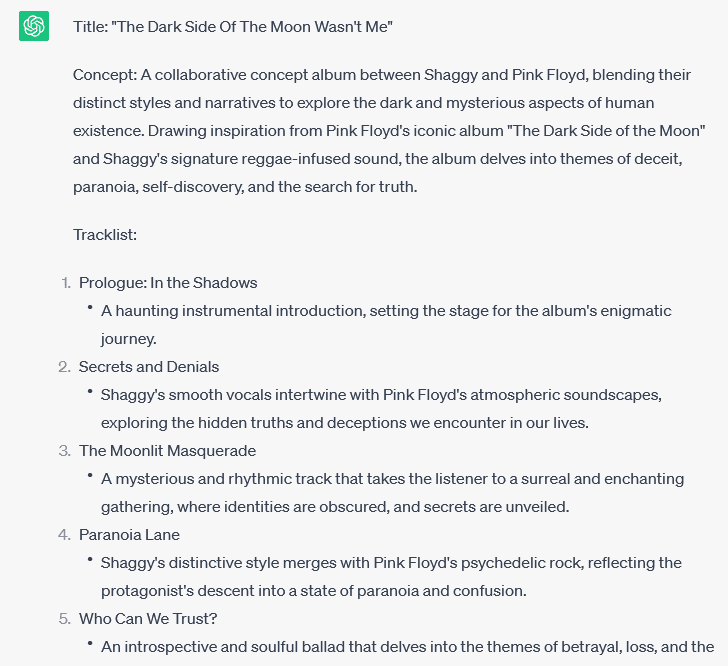
ChatGPT can’t yet listen to your unfinished demos for feedback, but this day is coming (poor ChatGPT). GPT4 can already describe images and perform advanced generative tasks, less than a year after OpenAI launched their internet-breaking chat bot.
Watch This Space
As AI technology continues to evolve at a rapid pace, it’s hard to keep on top of what’s out there and how it’s shaping music production.
We’ll likely see some standardization soon, with the best AI music plugins and apps rising to the top, and new industry standards minted. But if change continues at this pace, it will be challenging for these apps to stay relevant as competitors engage with increasingly advanced technology.
As for whether or not AI will eventually cross the line firmly into cheating territory, it’s difficult to imagine new ways for this to happen that aren’t already apparent. If using AI technology becomes the norm for music production, then our attention will be drawn to how people are cheating with it, not cheating because of it, and this whole argument will become antiquated.
If you enjoyed this also check out 6 Ways NFTs Could Disrupt The Music Industry