- Harmonic mixing helps DJs create smooth transitions between songs
- The Camelot Wheel is a tool that helps DJs find compatible tracks based on their keys
- DJs can improve their mixing skills with basic and advanced techniques
- Also, check out our post on the best music download sites for DJs
A DJ is not a jukebox. While a jukebox shuffles songs without any human touch, DJs can transform a collection of tracks into a captivating journey for an audience.
By thoughtfully weaving one song into another, you can create emotional arcs that leave a lasting impact on the dancefloor. This storytelling ability sets intermediate and advanced DJs apart from beginners; harmonic mixing is a key skill in achieving this.
Understanding Harmonic Mixing
Once you have mastered beatmatching, harmonic mixing becomes the next level of expertise to focus on. Harmonic mixing involves blending songs in complementary musical keys to craft a captivating story.
While atonal techno may not require harmonic mixing, for any DJ playing songs in recognizable keys, it is crucial to boring your audience by playing an entire set in one key or alienating your audience by creating awkward harmonic clashes during transitions.
One valuable tool for DJs is the Camelot Wheel, also known as the Circle of Fifths. This wheel organizes all 12 musical keys, highlighting their harmonic compatibility. Each key is assigned a number and a letter, making it easier to identify compatible tracks.
The Circle of Fifths and the Harmonic Journey
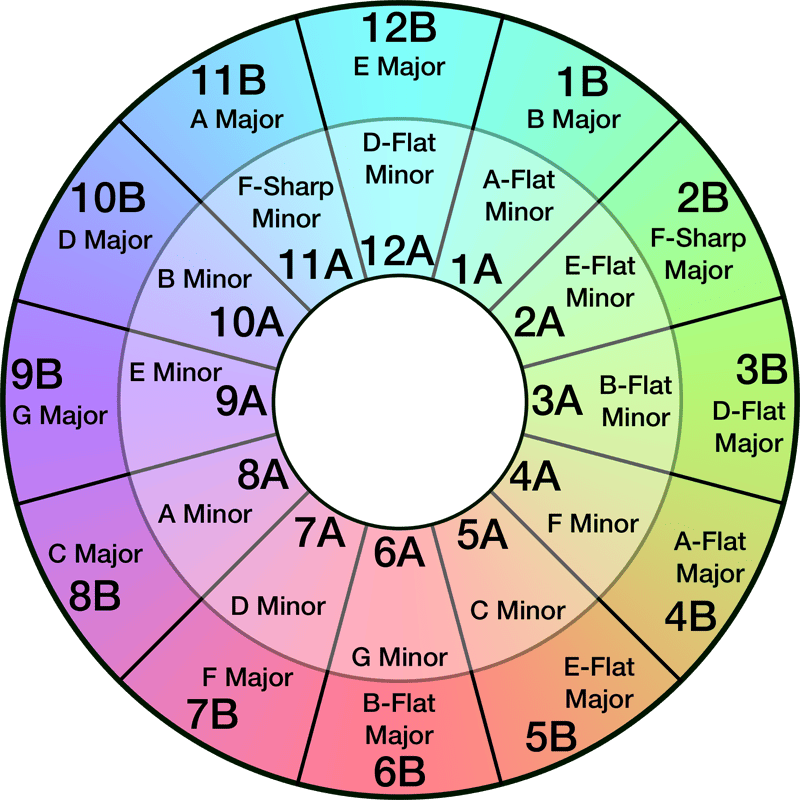
The Circle of Fifths consists of twelve keys, each being a perfect fifth above or below its neighboring keys. Perfect fifths are an essential foundation of music, the simplest possible chord you can play.
Choose any root note, then play the note that’s five steps above the root in key, and you’ll get a perfect fifth.
For example, in the key of C major, the perfect fifth is G: C (the root), D (second interval), E (third), F (fourth), then finally, the perfect fifth, G.
The most common chord in rock and roll is the famous “power chord”: a note, a perfect fifth above that note, then the octave above that perfect fifth. The inner ring of the Camelot Wheel represents major keys, while the outer ring represents their relative minor keys.
Transitioning between adjacent keys or between major and relative minor keys within the same sector of the Circle of Fifths generally sounds good.
Working your way around the Camelot Wheel clockwise, counterclockwise, or going back and forth between relative major and minor keys are easy options for organizing your set by key.
The step-by-step guide below describes some additional, more advanced techniques.
Wondering how to DJ with Spotify? Here is everything you need to know.
How to Program a Harmonic Journey

Use key analysis software like Mixed In Key, built-in key analysis features in software like Mixed In Key, or built-in key analysis features in software like Serato DJ Pro. This will help you understand the key of each track and guide your harmonic mixing decisions.
Once you know your tracks’ key, use these guidelines to enhance your ability to mix harmonically and take your DJ sets to the next level. Remember, these are just guidelines, not strict rules, so feel free to experiment and trust your instincts.
Level 1: Learn the Basics
Practice Mixing Tracks In The Same Key

Begin a set by mixing a few tracks with the same key signature. This is the easiest way to mix harmonically, creating a seamless and harmonious flow to orient your audience harmonically at the start of your set.
Learn To Transition Between Keys

Build on mixing songs in the same key by learning to transition between songs in adjacent keys: either up or down one number or between the minor and major keys of the same number on the Camelot Wheel.
This creates more harmonically-interesting mixes than just playing songs in the same key and makes for smooth transitions, and helps keep the audience’s attention, maintaining energy and interest in your mix.
Level 2: Practice Intermediate Techniques
Surprise Your Audience
Experiment with unexpected key changes once you have mastered mixing in the same key or transitioning to adjacent keys. Some will work, while others may not. Practice and listen objectively to learn to create memorable moments on the dancefloor.
Utilize Pitch Control Features
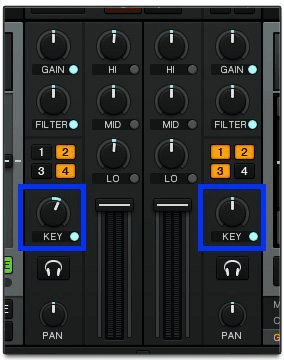
If you want to create harmonically seamless transitions between songs in non-adjacent keys, consider using the pitch bend feature in your decks or DJ software.
Temporarily change the key of a song by bending it up or down one or two semitones. This technique requires deliberate and rhythmic pitch transitions to maintain a thoughtful mix.
Learn Energy Boost Mixing Techniques
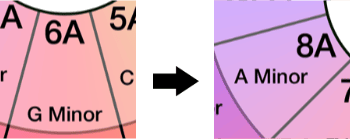
Energy boost mixing involves transitioning to a song that is one or two semitones higher or lower than the current song. You can find these songs by adding or subtracting two numbers on the Camelot Wheel.
Use this technique to avoid harmonic clashes to transition quickly and deliberately between songs.
Level 3: Master Advanced Harmonic Mixing Concepts
Use Helper Records

If your genre permits, incorporate an acapella in the same key as your song to add interest and variety. Acapellas with rapping or spoken content can act as a bridge between songs in different keys.
Another way to create interesting transitions is to use drum breaks found on battle break records to create a bridge between two records with incompatible keys.
Experiment With Harmonic Tension
Try mixing tracks in harmonically distant keys to build anticipation or create climactic moments. This technique adds a touch of tension and makes the eventual resolution more satisfying.
However, be cautious of unwanted noise and dissonance. Record your practice sessions and listen to them objectively to ensure the desired level of tension and release.
Know When Harmonic Mixing Isn’t the Right Choice
Sometimes, you may want to transition between two songs that don’t work harmonically. Once you master the techniques above, you’ll know when a harmonica transition isn’t possible.
In those cases, you can mix non-harmonically, using atonal parts of the tracks, such as drum-only intros or outros, ambient sections without identifiable melody, or well-placed slam mixes at dramatic moments.
These techniques allow you to shift from one key to a dramatically different key with style.
Wrapping Up
As a DJ, your goal is to tell a great story that resonates with the audience. While you can plan your set, remaining adaptable and responsive to the crowd’s energy is equally important.
Pay attention to their reactions and adjust your programming accordingly. The best moments often arise from spontaneous decisions based on the vibe in the room.
Harmonic mixing is a powerful tool that enables you to become the dancefloor storyteller the audience will remember.
FAQs
Why Is It Important To Mix In Harmony?
Mixing out of key can create unpleasant harmonic dissonance, similar to poor beatmatching. DJs can avoid this pitfall by understanding harmonic mixing and creating seamless transitions.
Is the Camelot Wheel the Same As the Circle Of Fifths?
Almost. The Camelot Wheel is a visualization of the Circle of Fifths popularized by Mixed In Key. It simplifies certain concepts, making it more accessible to artists not well-versed in music theory.
Can You Mix Tracks In Different Keys?
Absolutely! However, not all key transitions work equally well. The techniques in this article describe ways to identify compatible and incompatible key combinations.
What Is the Theory Behind Energy Boost Mixing?
Energy boost mixing is the DJ’s equivalent of what pop, rock, and R&B refer to as “modulation.” It involves transitioning from one key to a higher key, creating a sense of escalating energy.
Can You Mix Major and Minor Keys?
Yes, you can! Major and minor keys have a relationship that allows for seamless transitions.