- Understand the components that a Phono Cartridge and Styli are comprised of
- Gain insight into the types of phono cartridges & Styli available
- By the end of this article, you will be able to make an informed choice on the correct cartridge and Styli for your set-up
What are phono cartridges and styli?
A phono cartridge and its stylus (plural, styli) are essential components that translate the groove in a record into a usable audio signal.
The stylus consists of three main parts. The active parts include a diamond tip* that connects to a tiny arm called a cantilever. This combination of cantilever and diamond tip is known as the armature which is protected by a housing, which can be made of various materials.
The stylus housing press fits onto the cartridge. The cartridge attaches to the tone arm of the turntable.
*Sometimes, a stylus tip can be made of Sapphire

Physical record sales are increasing, and a new generation of people is discovering the magic of vinyl for the first time. There is no doubt that the process of cleaning, playing, and even smelling new vinyl is a visceral experience. For DJs, vinyl has long been the holy grail of mixing. It is poetic that thousands of people at a rave can enjoy a unified experience, dancing for hours to the amplified vibrations of a minuscule diamond.
“Somebody was trying to tell me that CDs are better than vinyl because they don’t have any surface noise. I said, “Listen, mate, life has surface noise.” – John Peel
How do cartridges & Styli work?
How many grooves are there on a standard twelve-inch record? Think about that question for a moment.
Of course, the answer is one! (remember that little nugget if you are a pub quizzer).
The groove in a record is one continuous spiral pressed into the vinyl’s surface. This is where the magic begins. When the diamond tip of your stylus is placed at the start of a spinning record, it begins a journey through that groove.
As the stylus (sometimes called the needle) travels, it reacts to the tens of thousands of intricate protrusions, notches, and recesses in the walls of the groove. The left-hand wall of the spiral contains information for the left-hand channel and vice versa.
The larger indentations and patterns make the lower frequencies, and the more detailed, tighter cutouts create the higher frequencies.
Because the complex patterns in the walls of the groove are the physical representation of sound waves, the vibrating diamond tip produces an audible facsimile of those sound waves.
Try this Experiment:
Press play on any record deck with your amplifier turned off, and you will hear the track playing very quietly.
What you hear are the vibrations of the diamond tip of the stylus feeding through the tone arm of your record player.
This phenomenon is called “needle talk”. The better your record player and tonearm assembly quality, the quieter the needle talk.
Of course, amplifying that needle talk with any level of quality is impossible, so a more technical solution is required. To achieve a level of signal that can be amplified, we use the principles of transduction or changing one form of energy into another.
In the case of a record player, we need to turn the physical vibrations of the needle into a usable electrical signal.
Let’s look a little deeper at each component used to achieve good sound.
Styli – What are they?

The stylus (or needle) sits at the point where the vinyl groove and cartridge meet. This component is responsible for translating the intricacies of the groove into vibration.
As the styli is physically touching the vinyl, it has the potential to wear or damage your records. Cheaper styli can wear out your records if not set up correctly.
Diamond is the most common material used for styli. Sapphire can be an option for more vintage players as their tonearms track heavier. As Sapphire is softer, those with heavy tracking turntables (Over 5 Grammes) could consider Sapphire to avoid damaging their records.
In reality, these players will likely be pre-1960s. While you can use a Sapphire stylus on modern record players, they have less than half the life of a diamond stylus. (In some cases, as little as forty hours of listening time).
Styli Shapes
The shape of the stylus’ diamond tip significantly affects both the accuracy of the vibrations produced and the amount of surface area in contact with the groove. Increased contact means more detail. However, increased contact also means more wear if the stylus is not set up accurately.
Over time, manufacturers such as Ortofon, Stanton, and Audio Technica have developed more technical designs to improve performance at a price, as well as their high-end offerings.
Picking the right stylus type is a case of balancing your needs with your budget. While an audiophile with a $20K hi-fi system would see $500 for a cartridge as a budget option, a DJ working in adverse environments and hammering their records regularly will need a more economical and robust solution.
Tipped (bonded) Stylus
Tipped or bonded styli are made from two components. The first component is the diamond (or sapphire) tip. The tip is then glued to a metal (often titanium) shank. Although cheaper to manufacture, bonded styli carry extra weight with the metal shaft and the adhesive, meaning tracking has to be checked regularly to avoid wearing out the groove of your records.
Tipped styli are considered the budget to lower-mid-range end of the market. More expensive designs will use a one-piece solid diamond and shaft fixed directly to the cantilever.
Both tipped and one-piece styli come in a variety of shapes.

Spherical (Conical) Stylus
A spherical stylus is a similar shape to the nib of a ballpoint pen. Because it has a larger radius than more expensive alternatives, the spherical stylus can only react to the larger indentations and ridges in a groove. This translates into less of the high-end detail that comes from the minuscule indentations in a groove.
Although the frequency response of a spherical stylus is perfectly adequate for DJ’ing and general use, Audiophiles prefer to spend more to achieve the marginal gains found in other types of stylus.
Nude Elliptical
An elliptical stylus is a more complex diamond shape and costs more to produce. The elliptical shape allows the stylus to ride the center of the groove like a spherical stylus but has two main advantages over its cheaper counterpart.
Increased vertical contact, coupled with the reduced front-to-back contact with the base of the groove, means better tracking and reduced wear. More importantly, there is a higher level of detail in the high-end and lower-mid frequencies when played on a mid to high-end set-up.
Flat Line Elliptical
The Flat Line design delivers precise tracking of high-frequencies while minimizing wear. This design features a vertical contact area greater than that of an elliptical stylus. The line contact stylus offers exceptional resistance to distortion and reduces the potential for wear on vinyl records.
It’s worth mentioning that due to its broader tracking footprint, the line contact stylus might introduce some additional noise when used with heavily worn records.
Hyper Elliptical and Micro-Ridge.
These are still Elliptical designs, with ever more complex tip shapes to achieve that all-important detail. At this level, things become a matter of personal choice and budget. You should audition these styles before purchasing them if you have never heard them before.
Shibata
Considered by many to be the ultimate in-shape design, the Shibata’s complex tip can reach the parts of the groove that other tips are unable to reach. As well as being an improvement on the elliptical designs, a Shibata stylus can breathe new life into records that are worn out by the other shapes.
Now that you have a broad idea of what each stylus type does, we can look at the technical aspects of turning the stylus vibrations into a usable audio signal.
There are two main types of technology are used to turn the diamond tip’s physical vibrations into an electrical signal:
Moving Magnet Cartridges

A moving magnet (MM) cartridge is the most common type of phono cartridge used in turntables. A moving magnet operates on the principle of electromagnetism.
At the heart of the MM cartridge is the cantilever with a tiny diamond at one end and a magnetized piece at the cartridge end. This magnetized piece is often made of iron or nickel and is positioned close to a pair of fixed coils. one for each stereo channel, within the cartridge body.
As the stylus traces the grooves on a vinyl record, it encounters variations in the groove’s depth and shape. These minute fluctuations cause the cantilever and magnet to move accordingly. According to Faraday’s law of electromagnetic induction, when a magnetic field (created by the vibrating magnet) passes through a coil of wire (inside the cartridge), it induces an electrical current to flow through the coil.
The simplicity and reliability of the moving magnet cartridge design have made it a popular choice among vinyl enthusiasts for decades. The moving magnet system is particularly popular with DJs and Turntablists because of its increased weight and value for money.
If we break down the stages of the process of a moving magnet cartridge (MC), this is what we see:
- The Diamond tip of the stylus vibrates in response to the shape of the grooves
- Those vibrations are sent through the cantilever, causing its magnet to wiggle back and forth.
- The magnet’s physical movement interacts with two sets of magnetic coils, one for the left channel and one for the right.
- The resulting interactions create two electric currents.
- The two electric signals are fed through wires to your amplifier, where they are boosted and sent to your speakers.
Moving Coil Cartridges

A moving coil (MC) cartridge is the other type of phono cartridge used in turntables.
Unlike a MM cartridge, the MC cartridge employs a different approach when converting the mechanical vibrations of a stylus into an electrical signal.
In an MC cartridge, a pair of tiny coils are fixed to the cantilever, and these coils are positioned within a magnetic field created by fixed, permanent magnets.
As the stylus tracks the vinyl record, the coils move within this magnetic field, generating an electrical current. This system still uses the principle of electromagnetic induction. However, in the MC design, the coils move rather than a magnet.
The MC cartridge’s coils are typically much lighter than the magnet in an MM cartridge. The reduced weight on the cantilever allows for a faster and more responsive reaction to the nuances of the record’s grooves. This results in a lower output voltage than MM cartridges, requiring a specialized and often dedicated MC phono preamplifier with higher gain.
However, the lighter components and subtleties of the MC’s construction deliver what many consider to be a superior listening experience.
Cartridge Type | Pros | Cons |
| Moving Magnet | Detachable, replaceable stylus for economical replacement. Much higher output level due to more copper windings and can use standard phono pre-amp Suitable For DJs. Lower cost than Moving Coil counterparts | Lighter weight makes tracking, damping, and set-up easier to achieve Much better audiophile sound reproduction than MM |
| Moving coil | Lighter weight makes tracking, damping, and set-up easier to achieve. Much better audiophile sound reproduction than MM | No option to change or replace the stylus separately. Small copper winding means lower output levels requiring dedicated pre-amps. Not Good for DJs as they are too light, sensitive to vibration, and delivers lower output. Audiophile component only. Can be expensive. |
Audiophile Cartridges

Audiophiles often favor MC cartridges for their exceptional detail, transient response, and ability to extract subtle intricacies from vinyl records. You can expect to pay anywhere from $200 to $13,000 for a moving coil cartridge.
This Moving Coil costs $13,000 and would only be considered for the highest quality turntables.
If those figures are frightening, then you should consider a high-end Moving Magnet cartridge—these cost $50 and upwards in the region for better quality designs.
This Moving Magnet, complete with the Headshell, is a snip at $200 – This combination works well with medium-range turntables like the Linn Sondeck LP 12
DJ Cartridges
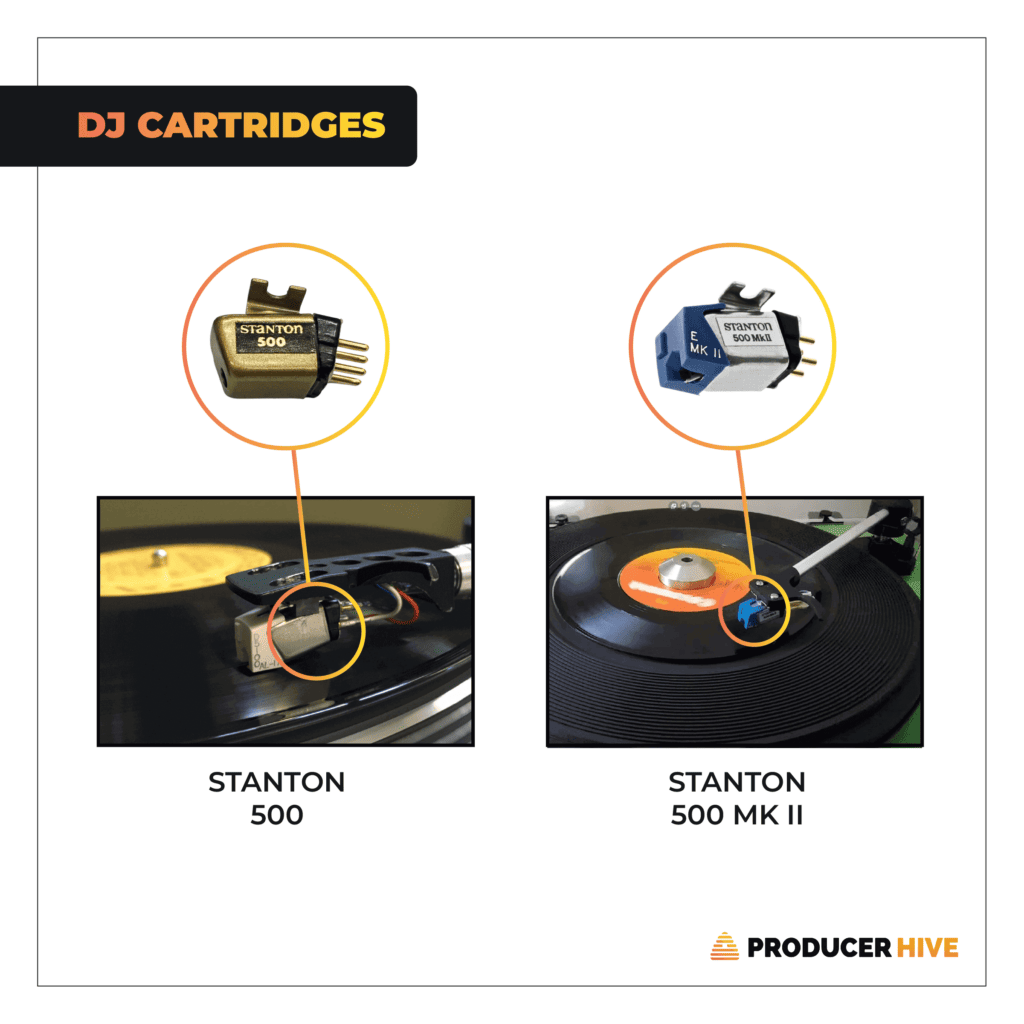
Over the years, the design of the club DJ cartridge has changed from the traditional Stanton 500 type used in the days of DMC scratching competitions to the highly advanced designs we see today.
The Stanton 500 and 500 MK2 were the staple for clubs worldwide until the late nineties. They became popular with turntablists and scratch DJs in the eighties. Replacement styli are very rare as they have fallen out of fashion.
DJs fall into two camps. Those that scratch and those that don’t. Scratch DJs will want a heavier tracking (3gms to 7gms weight) cartridge with a conical tip to reduce wear.
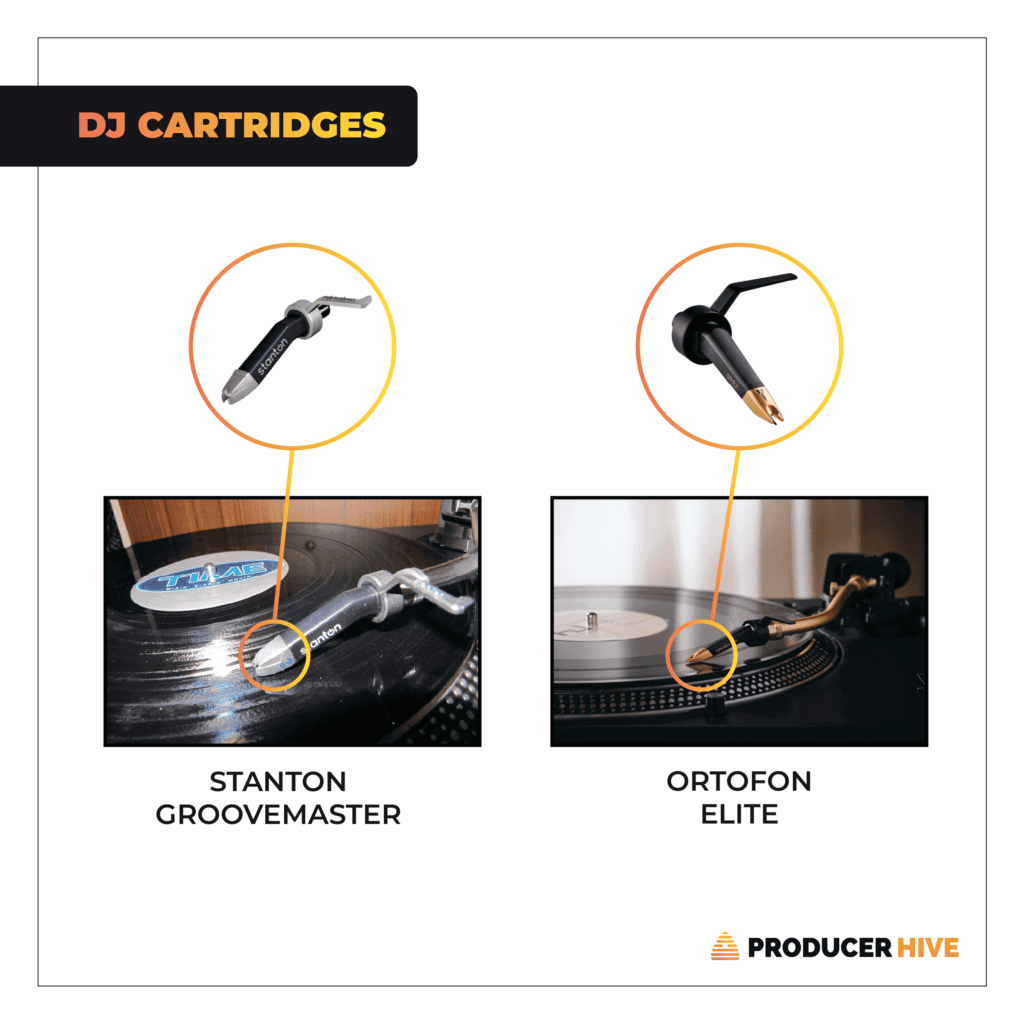
The Stanton Groovemaster is ideal for Scratching and Mixing. It is priced at around $80 and represents the entry-level professional cartridges.
On the other hand, club DJs will want lighter tracking to avoid wearing out their vinyl and more detail for better sound reproduction. (2gms to 3gms is ideal, with rounded or elliptical diamond.)
Ortofon makes a range of high-quality DJ cartridges. This Ortofon Elite retails at $369 and represents the top-of-the-market products. You will find DJ cartridges designed for mixing rather than scratching from around $80 and upwards.
FAQ
What is the difference between a cartridge and a stylus?
A stylus is the diamond-tipped needle that reads the groove, whereas a cartridge is the component that holds the stylus. It is attached to the tonearm and contains the magnet/coils and magnetic field where electromagnetic waves are created.
Can you put any stylus on any cartridge?
No. Styli are rarely interchangeable, and you must buy a specific stylus for your moving magnet cartridge. If you have a moving coil cartridge, the stylus is not replaceable, and you must buy a whole new unit.
How long does a stylus last for?
The average diamond tip stylus will last from 200 to 1000 hours. Although rare, Sapphire styli are sometimes found on vintage turntables or gramophones. These will last as little as 40 hours as Sapphire is much softer than diamond.