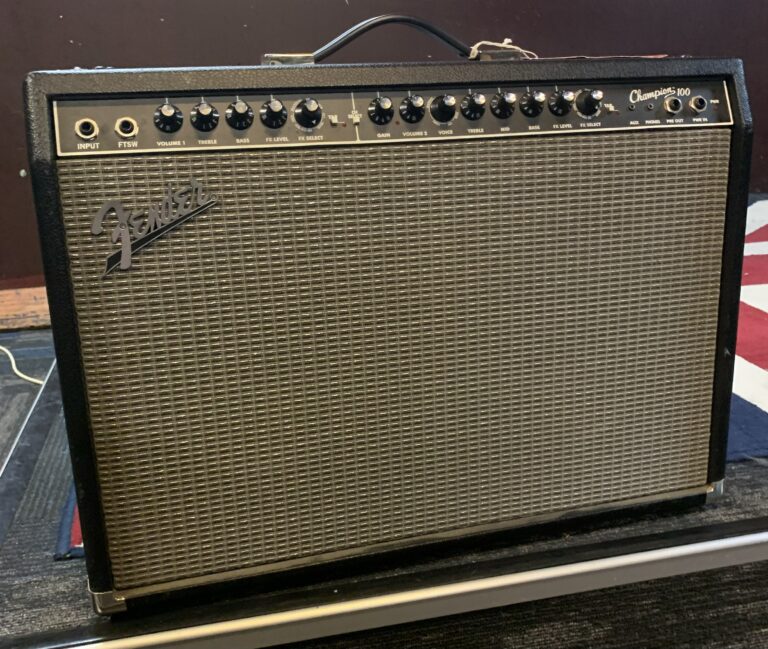
- In the market for a new bass combo amp?
- You’ve likely stumbled upon the 3 giants — Fender Rumble, Ampeg Rocket Bass, and the
Boss Katana. - This article examines where each excels and what each lacks.
Most first-time buyers of bass guitars tend to lean towards combo amps, as they are affordable, have the basic features needed to get a good feel for the instrument, and come in various sizes.
If you’ve done your research and are stumped on deciding between the Fender Rumble, Ampeg Rocket Bass, and
We’ll assess and score a winner for each of the following criteria:
There’s a lot to cover, so strap in and get ready for some amplified bass slappin’!
Fender Rumble Vs. Ampeg Rocket Bass Vs. Boss Katana Bass: Main Takeaways
- The Fender Rumble series has a broad array of tones. It has been on the market the longest, so has an edge in its reliability.
- The Ampeg Rocket is the new amp on the market, and offers innovative settings and a faithful recreation of the SGT (super grit technology).
- The
Boss Katana series is versatile, has good value for money, and has many settings. However, tonal options aren’t up to scratch compared to their guitar combo equivalents.
Breaking It Down
Build Quality
🥇 Winner: Fender Rumble
Seeing as the Rumble has stood the test of time, it’s an easy choice to award Fender for this category. The Ampeg and Katana are yet to prove themselves in the long term, even if Katana has done so for their guitar combos.
Fender Rumble
In terms of hardware, the Fender Rumble series is made of durable, strong materials such as lightweight plywood (strong and light), as well as aesthetic/protective build qualities such as grille cloths and amplifier coverings. It also has great, long-lasting circuitry perks such as a foot switch overdrive circuit and voicing palettes (Fender Rumble 100). This lends much versatility to the player and assures them of a long-lasting purchase.
Ampeg Rocket
Despite their lightweight profile, they are just as sturdy and portable as the Fender Rumble series. For instance, the RB-112 model comes in at 21.4 x 18.2 x 14.2 inches 543 x 462 x 360 mm. The lighter model is slightly heavier than its Fender Rumble counterpart.
The Ampeg Rocket series is fitted with the footswitch for the SGT overdrive settings, and also with auxiliary input and headphone output, as well as extension speakers and XLR outputs, meaning you can hook the Rocket up to a PA system, DI, or recording device.

Boss Katana
The
Sound Quality
🥇 Winner: Ampeg Rocket Bass
Any bassist worth their salt knows that Ampeg is chosen for its ability to put out solid, punchy bass tone. Combined with the onboard SGT overdrive, you can now get Ampeg’s legendary tone and sound quality, without the back-breaking weight.
Fender Rumble
Fender Rumbles have terrific sound clarity. Some have claimed to have discovered them to sound dull, but the overall feeling from bassists is that they are happy with it. It’s hard to find a reader review that was disappointed in the sound of the Fender Rumble.
The sheer variety of models will also show you that you can find one to suit your needs perfectly, with varying degrees of EQ nozzles on each. Spoiler alert, the larger ones generally have more.
Ampeg Rocket
The Ampeg Rocket series has all of the features of Fender’s Rumble Series. The only issue is that it doesn’t offer anything extra. Some have noted that there is little in the way of distortion options and that some of the models don’t have tweeters or DI volume control. This might not be an issue for all players.
It’s also worth mentioning that the new Rocket series improves on their previous BA series, which suffered from noise fan issues. If you were hesitant buying an Ampeg combo amp due to this, you’ll be happy to know that the new Rocket series does not have that issue.
Boss Katana
The
Versatility
🥇 Winner: Boss Katana Bass
Boss Katana Bass features a wide range of tone shaping options, including a 3-band EQ with a semi-parametric midrange control, a range of built-in effects, and the ability to customize and save tone settings using the Tone Studio software. It’s the most feature-packed out of the three amps, making it the most versatile.
Fender Rumble
The Fender Rumble series has a solid EQ variety. Using the bass, low mid, high mid, and treble nozzles, you can ring out the bright and thin. Or go the other route. Thick and warm by the same nozzles. You also have the advantage of overdrive, gain, and the ability to switch between the settings of bright, contour, or vintage.
Having used the Fender Rumble in rehearsal spaces, I can claim to have squeezed a characterful tone out of it. Functional, versatile. However, the general variety of the amp is rather limiting due to its basic capacity.
Ampeg Rocket
While the series does feature a 3-band EQ, the Ampeg Rocket series is more limited in its tone-shaping offerings. Unlike the
The Ampeg Rocket Bass generally sounds warm and thick in its low end and accommodates that scooped midrange sound very well. This makes it pair brilliantly with modern rock and metal.
As well as the EQ settings, Ampeg’s Rocket amps also have SGT (Super Grit Technology) which, with precision, can be used to add a nice amount of grit to your basslines. We can attest that it’s a fairly faithful recreation of Ampeg’s legendary distortion, so if you’re a fan of that — you’re in good hands.
Boss Katana
The
If versatility is your main concern, and often find yourself playing multiple genres in a single gig — this is the way to go. You get a 3-band EQ with a semi-parametric midrange control, a range of built-in effects, and the ability to customize and save tone settings using the Tone Studio software.
Pricing
🥇 Winner: Boss Katana Bass
Boss Katana wins in cost efficiency. However, with a purchase like this, it’s worth spending a few extra bucks to get the best value. After all, you will be using this bit of kit for a long time, and that time will be less valuable if you don’t like the amp.
Fender Rumble
Price-wise, the Fender Rumble varies. The amps with the smaller power levels are generally cheaper than the bigger ones. The 15-watt Rumble, for example, could cost you less than $100, whereas the 800-watt models cost almost a grand. In short, they are reasonably affordable.
Ampeg Rocket
For the Ampeg series, the cheapest models are more expensive than the Rumble models, but the most expensive models are cheaper than Rumble’s larger amps. The smallest and cheapest Rocket comes in at around $150, whereas the biggest at around $700,
Boss Katana
The