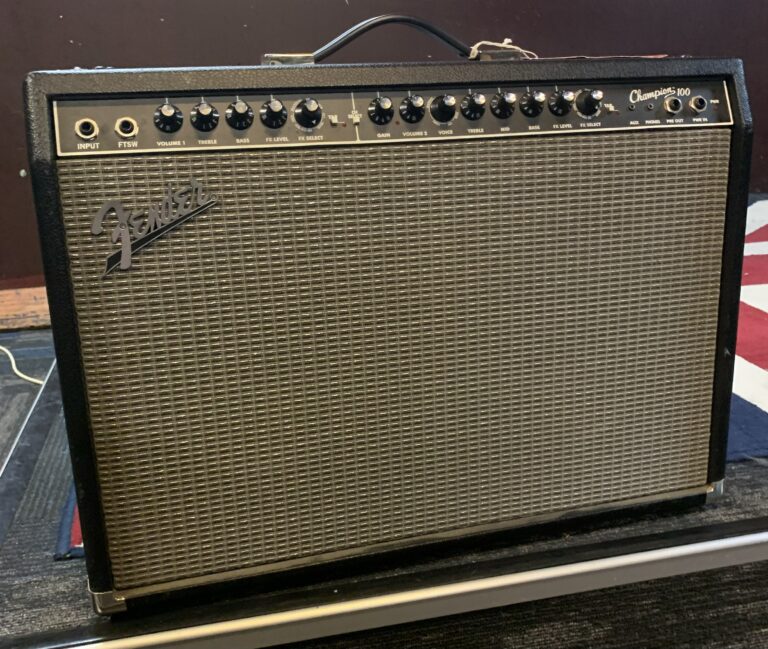
- Got your first bass amp and want to know how to use it?
- Study the nozzles on it. They’re the key.
- To understand them and how to adjust them to create a great tone, read on. We describe it all.
When setting your bass tone, there are a variety of factors that influence it. The room’s shape, the amp’s positioning, and your bass amp EQ settings. In live environments, the sound technician’s sonic skills factor into it in a big way.
But if you want the best control of your bass tone, knowledge is power! This article will grant you that wisdom.
Before we get into it, we should note that while knowing what each of your amp’s EQ nozzles do and how to handle them in all situations, the power is never entirely in your hands, as there are so many variables and factors influencing tone.
But the knowledge will give you the best chance of creating a great tone in various situations.

Bass Amps: What Do All the Nozzles Mean?
It’s all about tone. Every bassist will find their voice, but getting there requires knowing how each works. The main EQs are as follows:
- Gain
- Low/Bass
- Middle/Mids
- Treble/High
For different genres, they can be melded together in one way or another. But to give you a basic idea before we go into more depth, here are the basics.
| Setting | Features | Usage Tips |
| Gain | Distortion, crunch. | Turn it up for a thicker sound and down for less boominess. |
| Low | 40Hz-100Hz | Higher for heavier tones and lower for chilled vibes. |
| Mids | 400Hz-800Hz | Higher for a chunkier tone, lower to avoid overpowering other instruments. |
| Highs/Treble | 2kHz-6kHz | High-Frequency Detail |
| Presence | Turn it up for upper midrange clarity, and turn it down for a warmer sound. | Turn it up for upper midrange clarity, turn it down for a warmer sound. |
Understanding Your Bass Amp
Let’s start with the most basic factor influencing tone: the bass amp itself. Now, depending on your signal chain, you could have a simple or complex setup. This means you could have a direct connection from bass to amp, or the floor may be strewn with tuners, distortion pedals, and other gadgets that will affect your tone.
At first, it’s best to be as simple as you can. Strip it down both in terms of gear and the EQ settings themselves. Complexity comes later on.
Understanding The Dials
There are two schools of thought when approaching how to approach EQ on your bass amp:
- The first proposes that we set all the dials to 0 and boost them gradually, one at a time.
- Turn them all up to the medium settings (12 o’clock) and adjust from there.
Both are valid, and as a bassist, this is where you use your autonomy and decide which works best for you. Personally, I use method two – in my experience, it gives you a better frame of reference to work from if you are working from a ‘middle ground.’
The goal of EQ is to attain the best cohesive tone for a band, that nails low, middle, and high end sufficiently and without instruments overshadowing others. Let’s explore each of the dials in more depth and discuss further bass EQ approaches.
Gain
Distortion, better known as either gain or drive, controls the ‘crunch’ in your bass tone. It’s important to be careful with gain, as it casts a lot of influence over your tone. For a clean sound, you should have the gain low, and the master high.
If you want a touch of drive, have the master low and the gain up a nudge. For a terrifying tone of distortion, have the gain medium to high and the master low to medium.
Tip: If you are using a distortion pedal or fuzz primarily as your driver, you will need to pay attention to how much extra Gain your amp is providing.
Bass/Low
This is an essential part of your EQ, as it is used to bring out the low end and make your bass notes more pronounced. You may be thinking, hey it’s bass, and I’m a bassist, so crank it up fully! Not quite. Your bass amp is wired to bring out the low end, so there’s no problem there.
If your tone sounds thin, crank the bass or low-end nozzle up (gradually, mind). Conversely, turn it down if the bass is booming and feels like it’s swallowing up the entire mix.
Middle/Mid
Contrary to what many beginners think, the mids are more responsible for the ‘tone’ of the bass than the ‘bass’ dial. Aim to keep the middle moderate, or else you can interfere too much with the guitar tone.
Blend the mids until you feel your bass tone ‘gel’ with the guitars. Your bassline should fit snugly underneath the guitars, supporting them with the weight of your lower frequencies.
Too heavy on the mids and your bass tone will sound unnaturally honky. Too little, and your bass tone will lack clarity in the mix.
A Useful Note on Low Mids and High Mids
High mids and low mids are additional EQ settings that may appear on your bass amp. It may seem confusing, but it’s essentially a choice of whether you want the mids emphasized in the lower or upper mids frequency band.
So, the low mids will add more mids to the lows, and the high mids will add more mids to the treble. For balance, consider putting them both at midway.
Treble/High
Speak of the devil, time for treble! Treble boosts or attenuates the high frequencies. Some bands use more than others in their bass guitar tones, such as metal and punk. Others less, such as folk and blues. How much you use depends on how you want your tone to sound.
If you want it to be sharper, brighter, and have more attack, increase the treble. If you’re going for a chilled, warm vibe, have it low.
Also, you may have a bass-led song with some heavy focus on bass. Treble can accentuate the bass tone and make it stand out. It’s generally rare, and so most of the time, bass has a low treble.
All in one: EQ
Instead of the settings listed above, your amp may have a nozzle labeled ‘EQ’, which is essentially all of the above EQ settings rolled into one cohesive control.
Since turning it down will emphasize the bass tones more and the treble less, and turning it up will put more emphasis on the treble and less on the bass, you can turn it up for the sharper tone and down to make it more mellow.
‘Presence’ knob vs ‘highs’ – what’s the difference?
Yeah, they’re similar in that they both affect the higher frequencies. However, the “high” knob on a bass amp controls the level of the high-frequency content of the sound, while the “presence” knob controls the clarity and definition of the high-frequency content.
Use the ‘high’ knob to boost/cut high frequencies simply. Approach the ‘presence’ knob with the idea that you are dialing in the amount of high-frequency detail. If your bass amp has a presence knob, use it in conjunction with the ‘highs’ to shape the overall clarity of your tone.
If you’re unsure what you’re doing with ‘Presence,’ leaving it midway is an acceptable strategy.
How to Adjust the Tone

Too Muddy
This is usually due to an overbearing emphasis on the gain or the low-end EQs. You should turn the low end and gain down while turning the treble up to bring your tone back into clarity.
Too Powerful
If your bass tone is so intense that it overshadows your bandmate’s guitar tone, you can turn the mids, treble, and gain. Do so carefully, as you could end up with a thin and frail-sounding bass tone by the end of it. To make it chunkier again, you can turn the low end back up.
Too Shallow
If you want a deeper, more defined sound, you need to turn the mids and gain up. If necessary, nudge the gain up, too. This is a good way to emphasize the bass, especially for bass-driven songs.
Bass Amp Positioning
Where you position your bass amp is super important, as the soundwaves that emanate from your amp will be absorbed by the nearest objects they reach, from which they will either bounce off and fly back at you (acoustics) or be absorbed by it.
For instance, place the amp face to face with a wall, and the sound waves will be absorbed by the wall or projected onto them and fly back in a way where they will be squashed and just not sound very good.
It’s generally advisable to place your amp at the periphery of a room but not right up against the wall. Then, elevate it with a crate (as sound engineers will do in the recording set-up process) or chair so that you don’t lose any sound waves to the floor.
A Brief Guide to Genre Settings
Once again, what EQ settings you choose will stem from the genre, playing goals, and your influences. In that spirit, here is a brief cheat sheet of what to aim for to get the right tone for specific genres and styles. Adjust to taste!
| Genre | Bass | Middle | Treble | Gain |
| Rock | 7 | 4 | 5 | 5 |
| Blues | 5 | 3 | 5 | 4 |
| Metal | 7 | 3 | 3 | 7 |
| Warm | 7 | 5 | 3 | 2 |
| Bright | 3 | 5 | 7 | 1 |
Genre Settings: No One Size Fits All
Remember that EQ guides can give you a ballpark idea of what to set the nozzles too, but there’s no one-size-fits-all setting. After all, genre, style, and tonal uniqueness aren’t decided by turning your EQ to certain numbers.
Other factors also affect how you approach your bass amp EQ. These include:
- The Room
The size and shape of a room can profoundly affect tonal frequencies. A bar has a different vibe from a warehouse, which differs significantly from a narrow hallway. Yes, as a touring musician, you will deal with this. Sometimes, you are astounded at what is presented as a ‘stage,’ and the tone must be reconfigured to the new environment.
- The Sound Engineer
When you start gigging, you’ll come into contact with numerous sound engineers, each with their way of making things cohesive.
- Other Musicians
Your bandmates will also throw other tones into the mix, affecting the EQ of the sound as a whole. To remedy this, you must work together to attain a balanced tone that is also characteristic of your sonic goals.
- Additional Accessories
If you have other accessories, such as a versatile pedalboard, these must also be factored in for balance. That’s why it’s recommended to start simple until you know the ropes and gradually build it up. Your strings will also affect tone.
The Solution
There is no one ‘set it and forget it’ solution, but the more you understand your bass amp and what its EQ settings do, the better equipped you will be to deal with EQ issues as and when they arise. It will also teach you to be able to boost certain tones to make a character out of your music.
FAQ
Why can’t I hear my bassline when playing with a full band?
A common beginner mistake is to scoop out (reduce) the mids too much. Although it may appear rounder and more ‘pleasing’ to the ears when playing in your bedroom, this tone shape falls apart in the context of a whole mix.
Those mid frequencies are responsible for much of the ‘tone’ of your bass and will allow you to shape its definition. In the context of a full band, a bass lacking midrange will not cut through the mix nor sound good.
How do I keep my bass EQ under control?
Many beginner musicians mistake loud for quality, which isn’t the case. Boosting your frequencies can make your bass sound like it’s coming from all angles, which is not a good tactic for cohesion. Often, it’s a better approach to sculpting tone ‘out’ rather than adding more and more.
Also, don’t be afraid to leave the nozzles at 12 o’clock. A neutral setting can create a smooth and variable tone that can click with all of the other instruments and work well for solo practice, and many manufacturers design their knob values to work well when set midway.
How do I make my bass sound heavier?
Treble and gain are your friends if you’re going for the metal or punk edge. Remember to temper them, as whacking them up to full is usually overpowering. For a scratchy, bright, sharp sound, turn the treble up.
For a darker and warmer sound, turn it down. Simultaneously, use higher mids to sound thicker, more well-rounded, and down for a darker, tighter tone.
How do I make my basslines have more depth?
Turn up the bass nozzle. If the tone is still too thin for your liking, then crank up the mids. If you have the low-mid nozzle, put more emphasis on this. You can even play at the bridge pickup, as this will also accentuate the low end. The strings you choose also make a difference. Flatwound is the recommendation.
How do I keep the bass from clashing with other instruments?
EQ! However, don’t approach it from a mindset of trying to compartmentalize each instrument into its own frequency ‘range.’ Instead, focus on trying to ‘gel’ or ‘blend’ the instruments to fit together and sound like a cohesive unit.
The physics of sound dictates that there will naturally be a crossover between instruments in their frequencies. So, embrace the overlap and aim to lock in with the rest of the band.
Tip! Adjust your bass EQ while the entire band rehearses a song together. This way, you have a frame of reference. Pay attention to locking in your bass tone with the guitar and the kick drum. If your bass tone locks in with at least those two elements, you’re in good shape.