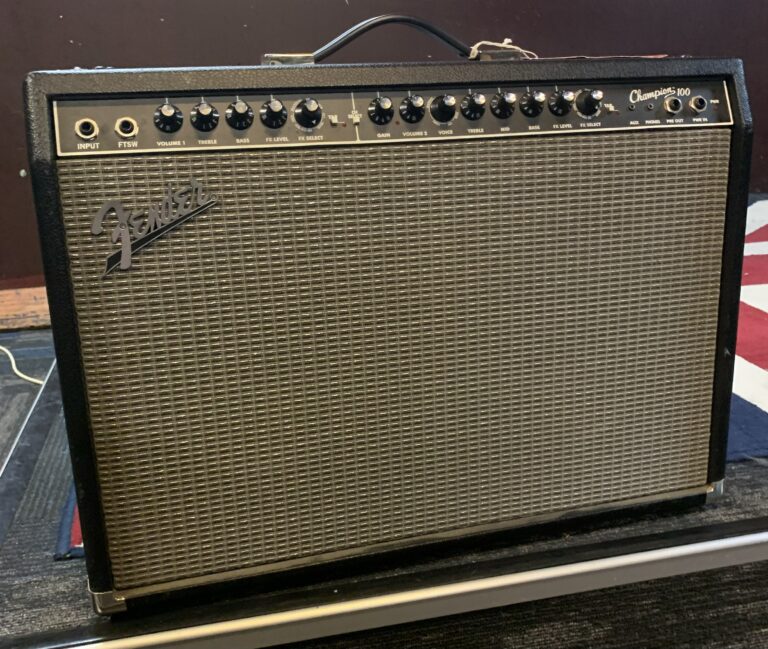
Are you looking into getting a tube amp? Then you might want to learn a bit more about ‘em. In this article, I will:
- Teach you how tube amps work
- Give you some cool historical facts about tube amps
- Talk about the upsides and downsides of getting this specific type of amplifier
Tube Amps: What They Are and How They Sound
Tube amps are the first type of amplifier ever created- They use vacuum tubes to amplify an instrument’s sound. They first came about in the early 1900s because of the technological advances in radios.
Tube amps have a rich, warm, and malleable sound that helped to characterize rock and blues as we know them today.
How Tube Amps Work

Tube amps are also called valve amps because they use vacuum tubes (aka valves) to amplify the sound. The first tube amp came around before the transistor. Yep, they’re really that old.
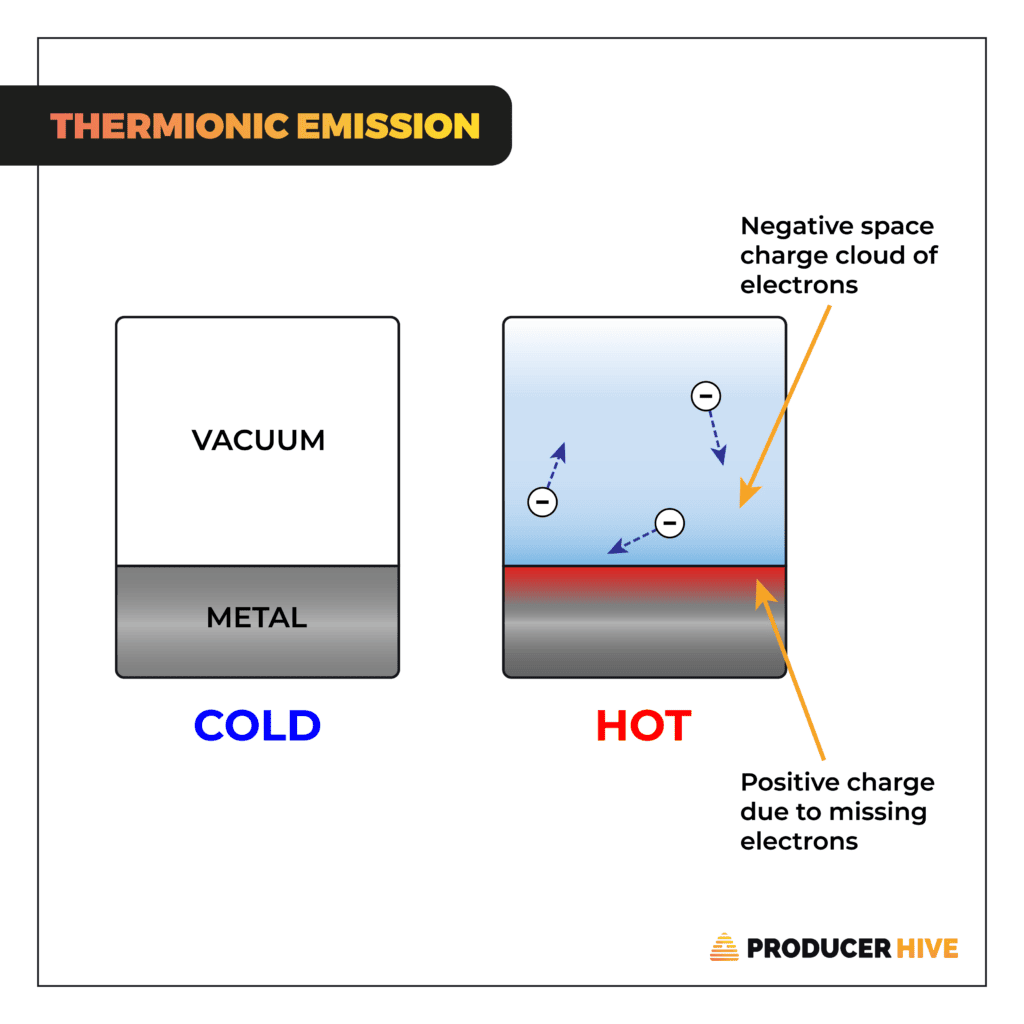
Tube amps are electronic amplifiers that work by thermionic emission. The amp tubes (hence the name) are made of glass and have electrodes inside. Tube amps can be filled with a low-pressure gas or a vacuum (the first tubes were vacuums, though).
It is also worth noting that there are two main types of tubes- Preamp and Power. Tube amps of old had both types.
The preamp tubes are smaller, and help add that characteristic warmth to the guitar’s sound, while power tubes can affect the sound of the amp and even the responsiveness.
Preamp tubes tend to last longer than power tubes. Power tubes amplify the signal (by controlling the flow of electrons) and are much stronger than a triode.
A Brief History
Tube amps have existed since the 1900s. Almost all amps up until the 1940s were tube amps. It all started with a very basic tube amp-The Fleming Diode- and the father of the radio.
The First Tube Amps
While the first semblance of a tube amp was created in 1750, we didn’t get anything close to the modern one until 1906. Enter- Lee De Forest.
Lee De Forest was an American inventor whose creation of the “Audion” vacuum chamber (an improvement upon the Fleming Diode) made live broadcasting possible. Hence the title “The Father of the Radio”.
He even wrote his doctoral dissertation on the radio (a paper called “Reflection of Hertzian Waves from the Ends of Parallel Wires,” but that’s beside the point!).
De Forest’s radio led from one thing to another, and he ended up working for a telephone company. As he continued to hone in on his Audion tubes, he learned that if he fed the output tube back into the grid, he had created a much more powerful transmitter than what currently existed.
Fast forward seven years later, and De Forest had created a 4-tube amp.
Later, the push-pull tube amplifier was invented. Then in the 1920s, a company called Western Electric would release their model A7- all helping pave the way for amps to become widely available.
The Williamson Amp
Let’s fast forward a bit. In 1947 the Williamson Amplifier was introduced. This was a push-pull amplifier designed during World War 2- and it remained the standard amp style throughout the decade. While it only had 15 watts of output, thanks to this model’s design, thousands of musicians were able to make their own amps. The Williamson Amp was based on an earlier amp but had a negative feedback loop.
That same year (1947) the transistor was invented, and thus the solid state amp–But it took a long time for these amps to become comparable in quality, so the tube amp continued to reign supreme.
Side note: Interestingly enough, the .1% total harmonic distortion (THD) rule of thumb comes from the Williamson Amp, and remains standard today.
1950’s-1960’s
By the time we got to the 1940’s the term ‘Hi-Fi’ had been coined. And from the 50’s-60’s, rhythm and blues turned into rock, speakers got better…and the golden era of music began. Tube amps during this time were honed in and more reliable. They continued to be popular until the 70s when solid states took over.
Pros/Cons of a Getting a Tube Amp
| Pros | Cons |
| Tube amps operate at a higher voltage overall | They’re large and heavy |
| They’re not likely to get overloaded | They don’t last forever |
| They have a natural form of compression | They don’t sound very good at low volumes |
| Harmonic Distortion | A lot depends on the temperature- And take time to warm up |
| They sound warm or smooth | They’re fragile |
| They create even harmonics | They tend to be pricey |
| They’re pieces of history/ are iconic | Tube amps can take up to 2 weeks to ‘break in’ |
This Big Pro: Warmth/Harmonics
Tube amps are highly sought after because of the unique warm timbre they produce. Another reason why people get tube amps is because of the effect they produce with high levels of gain the harmonics of a tube amp with the gain turned way up are far different than the harmonics at regular levels.
Harmonic distortion in a tube amp happens when something adds harmonics to a signal. To quote Luke Delalio…
“A badly designed circuit can add enough harmonic distortion that one can really hear it. There are amounts of harmonic distortion that can be very noticeable, and certain patterns of harmonics are more noticeable, and some patterns sound good, and some sound like shit”
The Big Con: Fragility&Changes Over Time
But a big con is that these tubes get hot. All equipment with tubes will eventually need to be replaced, which is a big project. According to the pros at Upscale Audio, most tube amps last about 2500-10,000 hours before needing maintenance.
The sound of your tube amp will likely change over time, making it a bit of a sonic wild card. Similarly, the temperature can change how it sounds too- Much like how an orchestral instrument doesn’t sound very good cold, tube amps have to be allowed to warm up.
Famous Makers and Models
Some famous makers you will hear about within the realm of tube amps include: Fender, Marshall, Vox, Roland, and Gibson.
Fender is well known for these models:
- Twin Reverb and Deluxe reverb
- Fender Bassman
- Champ
- Princeton Reverb
Tube amps were essential in getting that bluesy/rock sound we know and love today- Especially Fenders. For example, the “Blackface” Twin Fender Super Reverbs were used by guitarist Stevie Ray Vaughn. But those same twin amps were also used by many jazz greats, too, like John Coltrane’s band.
The 1950s Fender Champ is known for its characteristic twang, and the Fender Bassman for its power. Jimi Hendrix owned and used a Fender Princeton Reverb. But enough about Fender! Let’s look at some other famous makes/models.
Other maker’s famous models include:
- Vox AC30
- Marshall’s JCM800
- Mesa Boogie
Vox’s AC30 (Used by Tom Petty, and Tom Delonge) is a stunningly versatile tube combo amp that was first introduced in 1958 and is still going strong today. (Obviously…otherwise Tom Delonge probably wouldn’t be playing on a newer one).
Similarly, Marshall’s JCM800 was well received at its release (in 1981) and has a very popular reissue (Which is now used by modern heavy bands like Bring Me the Horizon and Halestorm).
Many different brands of tube amps stem from the idea of the Fender tube amp- But as genres changed, the amps had to change, too. One issue musicians ran into with Fenders is that they tended not to have enough sustain. One thing led to another, in the 1960’s a Fender Princeton was torn apart…And the first Mesa Boogie amp was born. By the time we got the the 1970s Mesa/Boogie had really entered the ‘chat’. Bands like Santana, Soundgarden, The Smiths, and Radiohead used their amps.
New Tube Amp Models to Check Out
The Vox AC4TV combo amp is a popular choice right now since it’s so small- It is based on the Vox AC4, which was a practice amp released in the late 50’s. Fender’s Hot Rod Deluxe is another new sought-after tube amp. It has a bright tone and huge sound capabilities, and is pretty portable for the size, too.
Tube Amps: Wrap-Up
As a whole, tube amps are a great option for those who know how to take care of them.
They’re an awesome piece of history that will- In my opinion- Never totally be replaced or eliminated.
Seasoned musicians will likely be able to tell the difference in sound quality immediately. But if you’re a beginner to early intermediate? A mid-range solid-state amp will probably serve you just fine.
Tube/Valve Amp FAQ
What is the difference between a tube amp and a solid-state amp?
Solid state amps use transistors and tube amps do not. Tube amps came before solid-state amps. They tend to sound more true to a guitar’s original tone but don’t produce very nice harmonics (especially the cheaper ones).
This article by our writer Kieran should answer any other questions you have about the differences between these two types of amps!
Why Are Audiophiles Obsessed With Tube Amps?
Some say that tube amps are more resonant- Others like the grit and warmth they have on their own. I think the real reason audiophiles are in love with tube amps is 1. Because they’re classic and 2. They have a harmonically rich and versatile sound that’s especially hard for low-end solid state to replicate.
Are Tube Amps Having a Resurgence?
I’d certainly say so, they have been popular for a while. Artists like Noel Gallagher, John Mayer, Alex Turner (The Artic Monkeys), and singer-songwriter Courtney Barret all have been known to play on tube amps.