Dolby Atmos is gaining traction among streaming platforms and music producers. So, how did this exciting format come about, and what does the format promise for the future?
Dolby And The World Of Cinema
Once upon a time, we began to tell stories on the big screen. Although the history books argue over the exact year and location, projections onto the screen started in the late eighteen hundreds.
In those days, movie sound came from the in-house orchestra or musician, and dialogue appeared as subtitles. Then came the “talkies”. With film now delivering audio and movie pictures, a speaker was required.
Mono
Mono can be notated as 1 (as in, one speaker)
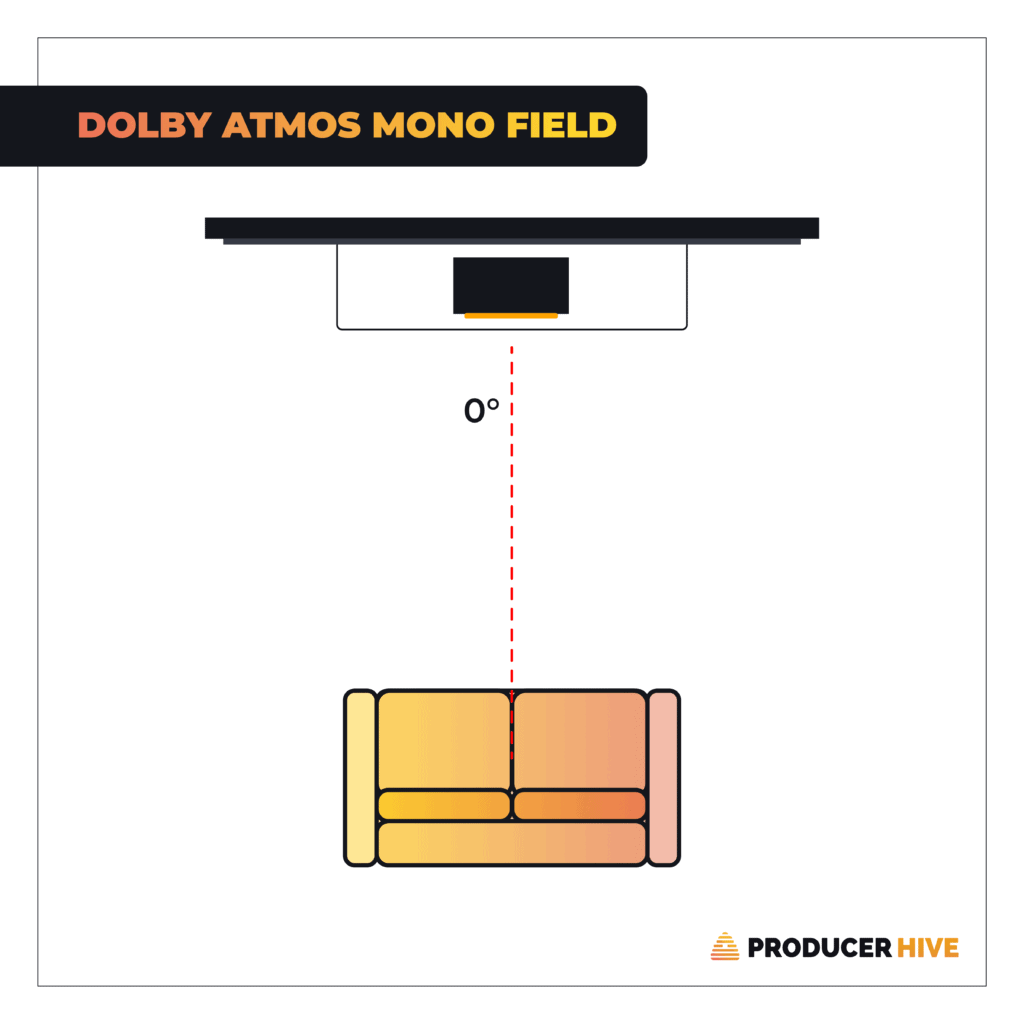
Perhaps some felt it was a step backward when the musicians were dropped in favor of a single mono speaker at the premiere of the Jazz Singer in 1927.
Stereo
Stereo speakers could be notated as 2 (as in two speakers – Left and Right).

“Stereophonic” sound was invented in the 1950s. With left and right speakers on either side of the screen, the audience was wowed when the sound of various objects appeared to move across their field of vision. It soon became apparent that dialogue could appear weak, especially when there was a lot of other sound fx going on.
Whereas a mono speaker meant the dialogue came from directly behind the screen, stereo speakers created a “ghost center” where the signals from the left and right speakers overlapped.
The problem with a ghost center is that you need to be sat directly in the hot spot to perceive the sound coming from the screen. If you are sitting on the left-hand side of the movie theatre, the dialogue comes from the left speaker and vice versa.
This is problematic for the human brain. If you are looking at the screen and watching an actor speaking, your brain expects the voice to come from the screen, not to one side of it.
The Center Speaker
Stereo and Center could be noted as 3. (Left, Right and Center)

The solution to the issue of the direction of dialogue came via the addition of a center speaker. With a three-speaker set-up, an engineer can keep all the main dialogue in the center speaker and place the sound fx in the left and right channels as appropriate.
Additionally, the engineer can pan sound across the screen. Let’s say a horse and cart enter the screen from the left and traverse across the screen to exit right. The sound will travel from the Left speaker to the Center speaker and then to the Right speaker. With a three-speaker system, there is a far more robust sound stage in front of the audience.
Dialog is clear and sounds that traverse are more fluid without the audio drop-out that sometimes occurs when panning left to right without a center speaker.
Surround Sound

Surround sound has existed in some form since the late 70s. However, the launch of Batman Returns in 1992 propelled the concept into the consciousness of the movie-loving public. Surround sound became accessible to home movie buffs with the development of Dolby Pro-Logic that same year.
Surround sound began standardizing to a six-speaker set-up. Left, Right, Center, Rear Left, Rear right, and a Low Frequency FX speaker.
The low-frequency FX speaker is not strictly a subwoofer, as it carries on low-end FX-like explosions and crashes. When playing back music through a surround sound system, no bass signal ever reaches the Low-frequency FX, unlike a subwoofer system.
Surround Sound is notated as 5.1 (The one is the Low-frequency Speaker – the remaining five are Left, Right, Center, Rear Left, and Rear Right.)
Dolby 5.1 / 7.1 and 9.1 (9.1 has extra speakers on each side, between the front and rear speakers), which have been home cinema staples for many decades.
Musicians soon got on board, too, with 5.1 surround remastered box sets becoming incredibly sought after by those who wanted more from their Pink Floyd or Jean Michelle Jarre experience. You would be forgiven for thinking that surround sound had reached its pinnacle.
Dolby Atmos

5.1 / 7.1 and even 9.1, while incredible to listen to after stereo, are not perfect. The problem with those setups is that they are fixed-point systems. Despite all those years of development, we still had the same problem as the old two-system. How so?
In fixed-point systems, sounds can be placed in specific speakers around the room. Because the information is “fixed,” the audio can still drop out when traversed from, say, the front left speaker to the rear right. In other words, there are still many “ghost” areas in the 360-degree ball where the listener sits.
In 2012, Dolby Atmos introduced a new level of immersive audio, which solved the 3D problem once and for all.
| Year | Milestone |
| 2012 | Dolby Atmos introduced for cinema use |
| 2014 | Dolby Atmos introduced for home theater use |
| 2015 | Dolby Atmos introduced for mobile devices |
| 2016 | Dolby Atmos introduced for gaming |
| 2017 | Dolby Atmos introduced for headphones |
How Does Dolby Atmos Work?
We have another article that explains how Dolby Atmos works as a type of ‘immersive audio format’, including the set-up required to mix in Dolby Atmos.
Put simply, a 9.1.4 and above speaker system, in conjunction with a Dolby Atmos decoder, will deliver full spatial sound.
9.1.4 Re-imagines the speaker layout.
Instead of the traditional Left and Right, Front and Back, the Dolby Atmos set-up has a Front field, a Side field, a rear field, and a height field. This system is not a fixed point system. With a Dolby Atmos, engineers can place beds; EG a stream babbling in the front left speaker, and objects.
With the addition of height speakers along with the ability to mix signals between multiple speakers, it is now possible to perceive objects in a given space within a room. For example, a helicopter flying across the room, back to the center, and then circling the room will be perceived as being in the right spot from anywhere within that room.
Naturally, not everyone can have fifteen speakers in their living room. That is why headphones are an important part of the Dolby Atmos experience.
Dolby Atmos is a very exciting concept. With music streaming platforms getting on board and many people switching to 3D spatial sound in the worlds of Gaming, VR, Movies, and Music, producers will need to start thinking about how their content aligns. I look forward to mixing a track down in Dolby Atmos with Devon-based Sound Engineer Paul Caboche.