


- Find out how the Sennheiser HD660s perform.
- Learn which vital metrics to check when purchasing headphones.
- Check your requirement against a handy reckoner to see if these headphones suit your needs.
The Sennheiser brand is synonymous with quality sound and durability. The HD25 range has been a staple of many DJs for decades. In the studio, though, the Sennheisers face stiff competition from Beyerdynamic (DT range), AKG (K Range), and Yamaha’s MT8.
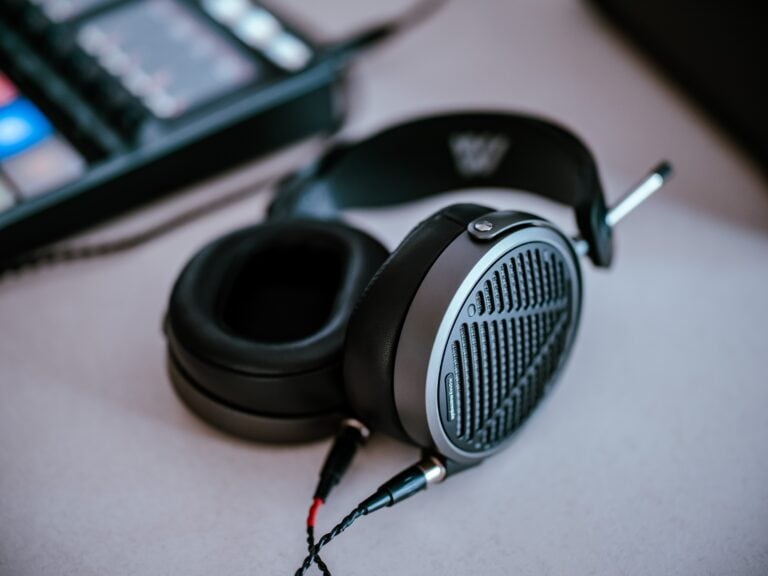
The HD660s continue on the legacy of their predecessors, the HD650 & HD600. Renowned for crystal clear sound, comfort, and pin-point detail, the older models set a high bar. Sennheiser has wisely avoided re-inventing the wheel regarding design, looks, and performance and has made minimal but significant changes. Although visually similar, the HD660s are identifiable by the discreet “S” logo on the grill panel and a darker finish.
In this article, we will take a detailed look and determine if the Sennheiser HD660S deserves its place in your studio.
Overview
If you are an audiophile looking for entertaining reproduction of your favorite music, then the Sennheiser HD660s may disappoint. Their sound is immersive without being colored and they are incredibly comfortable. However, their performance is more like studio reference monitors, which can be perceived as tiring over time.
You will not be disappointed if you are a music producer requiring transparent sound to facilitate critical mix decisions. Whether used in standard stereo mode or with sonic calibration and room modeling software, the Sennheiser HD660s are outstanding. With Sennheiser’s large ear cups, long listening sessions are a breeze.
Review

I purchased my HD660s when lockdown 2 was in full swing. Like many producers during that era, I quickly discovered that neighbors and family were not nearly as enthusiastic about repetitive beats and detailed audio editing as I am. My Mackie monitors were two-hundred miles away, much of my studio gear was in storage and my trusty Yamaha MT8s needed a new cable. With Yamaha out of stock, a film soundtrack to edit, and tracks to write, I had to take the plunge.
As a music producer, you become very tuned in to your equipment. Any change in environment, monitor speaker, or set-up can throw you out for quite a while. With the MT8s sidelined, I only had one other reference point; the Sennheiser HD650, which I had owned previously. A quick read-up revealed that the model had been discontinued, and while there were some deals on clearance models, there was a new kid in town—the HD660s. I was apprehensive about buying a new model without a demo, but there were some good reasons to consider the 660s on paper.
Out of the box, the HD660s come with a 3.5mm adaptor, a standard headphone cable, and a balanced headphone cable. Unfortunately, they are not suitable for Smartphones or tablets without a pre-amp. These headphones are open back and are not designed to keep sound in. Expect to irritate commuters and anyone in the same room as you, or better still, buy closed-back headphones.
What makes the HD660s so good for producers?
Sennheiser claims that the subtle improvements to the range result in a much-improved performance. I can vouch that they sound as incredible as I had hoped. The performance of the 660s is down to their heirloom design. Building on proven design is a wise course of action. The changes made are subtle but significant.
1. Impedance
Sennheiser has reduced the impedance from 300 ohms to 150 ohms for the 660s. What does this mean in the real world?
Impedance in speakers refers to the resistance the speaker presents to the flow of an alternating current (AC) audio signal from the amplifier. It is measured in ohms and affects how much power the speaker receives and converts into sound. Lower impedance demands more power from the amplifier, while higher impedance requires less power. You should match speaker impedance to the amplifier for optimal performance when buying headphones.
With their lower impedance, the 660s require less current to drive them and therefore sound marginally louder than the 650 in a direct comparison situation. However, as with most audiophile products, you should not expect a smartphone or tablet to be able to drive these headphones.
2. Driver Construction
While Sennheiser is understandably guarded about the details of their driver construction, the HD660s has an improved soundstage and bass response over the HD650. This is where we get into sticky territory, as listening is mainly subjective.
As a producer, I want minimal coloring and frequency change. As the HD660s is more ‘natural sounding’, you will likely perceive the HD660s as having less bass than the HD650. This may not suit the taste of those listening for entertainment purposes.
3. Damping
If you look through the mesh and closely study the HD660s and HD 650 driver sections, you will see that the entire diaphragm has been redesigned. The dampening material is entirely different from the old version.
In a headphone, the diaphragm refers to the thin, lightweight material that vibrates when an electrical signal (audio) is passed through. This vibration produces sound waves, which we perceive as sound. The diaphragm is crucial for converting electrical signals into audible sounds.
The interaction between the headphone diaphragm and the damping material is crucial for optimal sound performance in headphones. Damping materials are used in headphones to control and dampen unwanted vibrations and resonances that can affect the overall sound quality.
The choice of damping materials and their placement is essential in achieving the desired sound signature of the headphone. Different materials, such as foam, felt, cotton, or various polymers, can achieve different damping effects. Headphone manufacturers carefully design and tune their headphones to strike a balance between controlling resonances and preserving the natural sound characteristics of the diaphragm.
By effectively managing unwanted vibrations and resonances, damping materials play a significant role in improving the headphones’ overall sound quality and clarity, providing listeners with a more enjoyable and immersive audio experience.
It is noticeable that the HD660s delivers vocal parts clearly and precisely. The midrange does not suffer from the distortion that can plague studio headphones when making bass-heavy, big-beat music. In this regard, the HD660s are better than my memory of the HD650 sound.
Wrapping Up

In the studio, the HD660s have delivered in spades. The 660s are lightweight and comfortable. Critical mixing decisions are made with confidence. If you use modeling or calibration software, such as Waves Abbey Road studio, or Sonarworks ID Reference, you will find the Sennheissers in the default headphone presets.
If you are an audiophile, you may love them, or you may hate them. Of course, sound is subjective, and you will want to demo any significant purchase using music you both know and love.
For more on Sennheiser check out our review of the MD 421-II.

I own a pair of these headphones and I am enjoying a Ray Lynch album via Apple Music subscription. I’m also using the 10 dollar Apple dongle/dac. My device is an Apple 12 inch pro iPad, circa 2018. I’m not having any problem powering the HD 660S.
Thanks for your article, I found it quite stimulating….