- Musical moves to stay away from
- Music theory to help make your chord prog more unique
- A few advanced tricks that pro songwriters use
- Also, check out our post on basic guitar chords!
Are you tired of sitting down at the piano just to play the same chords repeatedly? 1, 5, 1, 5….
Then, it’s no wonder why your creative juices aren’t flowing. I know that when I don’t have a good chord progression, the lyrics don’t come, and I just can’t seem to flesh any ideas out.
So, in this article, I will create a guide to help get you out of that songwriting rut. We’ll look at ways to captivate your listeners through emotional chord progressions.
By the way, if you already have a melody and want some emotional-sounding options for the chords, the free Melody To Chords Generator is worth a go. I like the ‘Colorful’ setting for that softer, more open sound.
How to Write Emotional Chord Progressions
Cadences: Don’t Overuse 1 and 5

1 and 5 (A.K.A C and G in the key of C) are the bread and butter of Western music- but how filling is a sandwich with only bread and butter?!
Every once in a while, I can eat a piece of bread and butter. But it’s much better with something else. At least a tomato and salt and pepper, but preferably some protein, too…
I’d go as far as to say many pop artists and classical musicians of old have done this V I V I V move far too often and for way too long.
You know at the end of the symphony the orchestra keeps toggling between those two chords?
If it went on for too long (rather than just at the end), you’d probably get up and leave. How long would you like to listen to the below track on repeat?
You can write whatever you like at the beginning of a musical sentence, be it dissonant or consonant. How you end the phrase matters most, so we’ll start there.
Sample 1:
The above music doesn’t feel very heartrending on its own because you have to make people work for it and wait for the resolution.
So, with all that being said, let’s find the meat and cheese of the music. One really easy way to not overuse 1 and 5 while writing a chord progression is to learn about different cadences.
Cadences are like a comma or a period in a sentence, they denote a shift in something. But not all pauses need to be 1 and 5.
The plagal cadence– going from 4 to 1 (F to C) can get you a chill, relaxing semi-resolved sound that may remind some folks of ‘Ah-men’ at the end of a church hymn.
But it doesn’t always feel like sacred music, and it’s a great move to pull if you’re not quite finished yet.
Sample 2:
Deceptive cadences, on the other hand, trick us into thinking we are going to get the one chord but gives us something else. 5 to 6 (G to Am) leaves something to be desired.
Listen to this, and notice how it feels you leaving with a question mark. Use this cadence when you want it to feel like there’s more to be said, and leave folks craving an emotional resolve.
Sample 3:
You can also mess around with the way 5 and 1 themselves. Terms like authentic cadence, imperfect authentic cadence, and so on are referring to what notes are where when going from 5 to 1.
- Is the root C?
- Is the top melody line at the end of the phrase C (the tonic)?
If the answer to both questions is yes, then this is a perfect authentic cadence, which is meant to feel completely resolved.
If you want the listener to be 100% at ease, close the song or a significant phase with I and V, with the root of the chord in the bass, and up top (C on the lowest note and as the highest note).
Sample 4:
Half cadences are also very easy to employ, and give you a feeling the chapter is done, but that the book isn’t. To pen a half cadence, end a phrase on V (G).
I don’t expect everyone to dive deep into the intricacies of cadences, but knowing that you can alter the ends of musical sentences like this is very helpful, at least to me!
Adding 7ths

One easy way to make a basic chord progression you’ve to feel more interesting and emotionally ripe is to add dominant 7ths.
To do this, take a chord and add another third up top. For example, in C major, this would be C-E-G-Bb. Go up a minor third from the last note (fifth) of the chord.
Notice I didn’t say B natural! These two samples show what just adding dominant 7ths can do to the sound.
Sample 5 – This is an example with no 7ths:
Sample 6 – This is an example with primarily dominant 7ths:
Sample 7 – This is a sample with major 7ths:
If you choose the 7th that is in the key C-E-G-B (a major instead of a minor triad above) that will give you an interesting sound, too, but the dominant 7ths are more common.
These 7th chords are often called ‘the most important 7th chord’, and for good reason; they spice things up and are very versatile.
There is a significant amount of dissonance in dominant 7th chords, which gives you a lot of notes you can play over it.
Also, the way you invert them really matters. The further you place the half step (C+Bb) away from it, the more consonant it will sound.
Sometimes, you might want some intentional crunchiness, so know that placing the C and Bb next to one another is a move that you can make.
Another option is to just make just the V chord a 7th chord… it’s not as complex of a sound but makes cadences a bit more interesting.
Smooth Things Out With Inversions
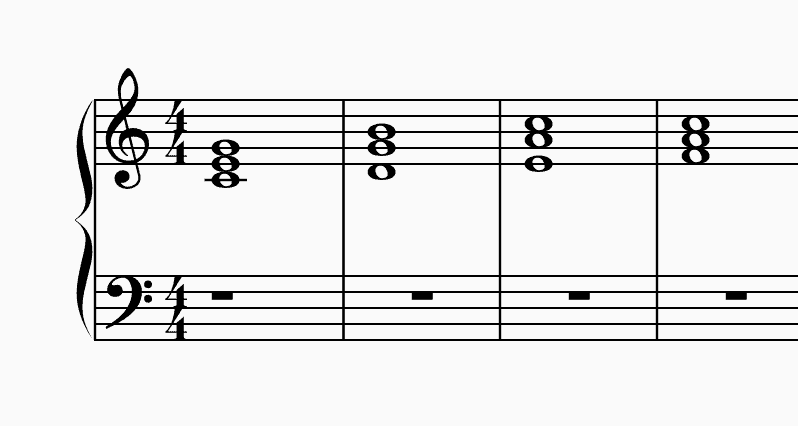
Inverting your chords can completely change the feel- while yes, the chord is still the same chord, you can change the way one note transitions to another from chord to chord.
If you want to write an emotional song, clunkiness won’t do. So if you like the general idea of a chord progression you’ve written, but something about it feels, well, blocky, try using inversions rather than all block chords in root position.
They’re easiest to see on the piano, but perhaps that’s just my classical brain.
Check out the difference in sound here. (Note that I did exaggerate the first track with a bit of staccato, as I felt a bit sassy about folks who only use root position chords…I digress).

Sample 8 – No inversions:
Sample 9 – Inversions:
If you add sevenths and then think about inversions, a basic chord progression now has a lot of ways to be subtly changed.
Change Keys (Modulate) for a Big Impact
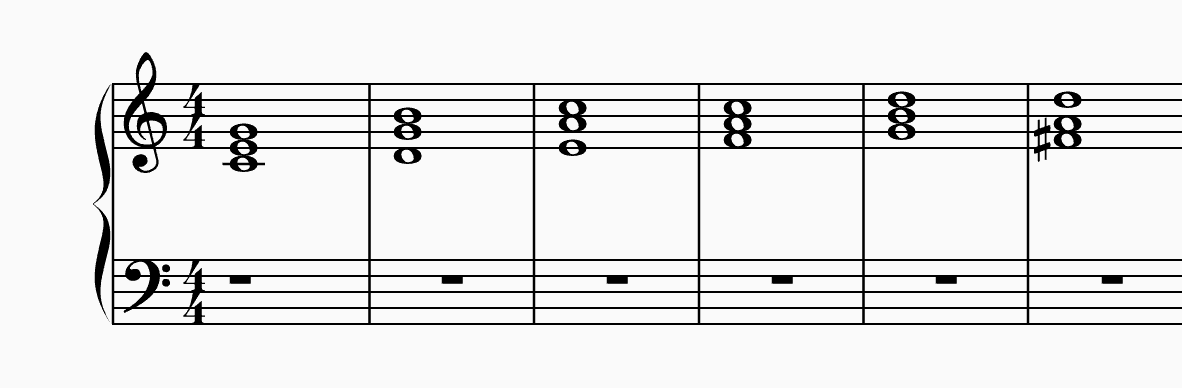
There’s a good reason why Taylor Swift’s “Love Story” gets stuck in the heads of non-Swifties years after its release: The key change.
One of the best pop power moves is moving the key up. But the hardest part about changing keys in a tune is the transition.
In “Love Story,” the last chorus moves up a whole step. This gives the whole song more gravity and leaves you coming away from the tune, feeling compelled to dive into your own nostalgia.
Sample 10 – T Swift-style modulation:
Bonus points if you can spot the above minor chord that isn’t in the original… Had to include it for copyright reasons!
Make Things Melancholy or Bitter by Utilizing Minor Sounds
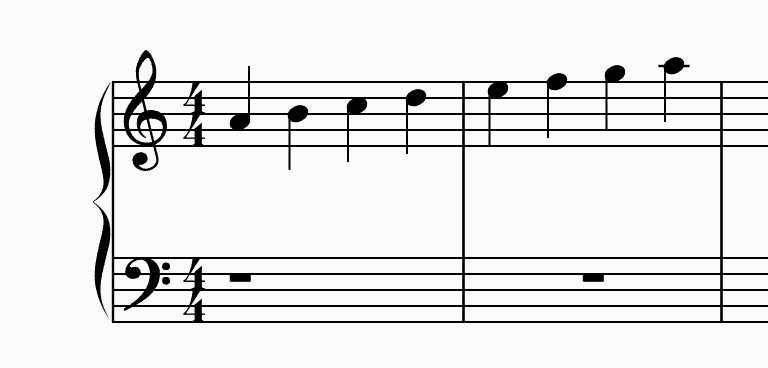
Writing in a minor key may feel intimidating at first, but it’s not as bad as you might think. The more I play guitar and talk with jazz colleagues, the more I see a minor key as a major key just starting from a different note.
If you don’t have all your key signatures memoized and you want to write something that pulls on the heartstrings, just start writing in A minor! An easy way to do this is to play all the white keys on a piano from A to A.
Sample 11 – A Minor:
You can also make things sound very sinister by converting an already-major song to a minor. Music theory buffs have a bit of fun with this by switching something in C to its relative minor, A.
Speaking of Taylor Swift, this is an example of how big a change in modes can make a song …
Don’t sleep on the minor chords that are already inside the key of your song, either.
Incorporating minor into the bridge of a song is a great way to set the song’s section apart from the rest.
In the key of C, that would be E minor and A minor. And it’s actually really common for people to not change chord progressions from the chorus to the bridge, which is a missed opportunity in a lot of cases.
Try Your Hand at Well-Known Progressions
These three chord progs are emotional-feeling by default. Spend some time with them, and then borrow what you like for your own progression.
Sample 12:
1 6 5 4 Aka. Axis of Awesome’s “4 chords” is actually a great emotional chord prog…but do you know why? It doesn’t put 1 and 5 next to each other, creating that clunk, hiccup, or worse yet, that ‘It’s over’ feeling in your body when it’s far from it!
Sample 13:
What’s known as the “Evanescence” chord progression is another super easy prog to have in your Rolodex to get your gears turning.
It is most often used on tunes with piano, but putting this 2-chord progression on guitar or any other instrument you like will still pull on the listener’s heartstrings.
This progression is simply a 1 chord to a minor 3 (if we were in C, that’d be C to Em). If I were to make an Evanescence-inspired tune, I’d probably use the 1 to minor 3 move in the intro, and then add some more chords in later.
Sample 14:
Another extremely popular chord prog is Pachabel’s Canon ( swear even Green Day has used the Pachabels Cannon chord progression).
But hey, there’s a reason why this Classical now-exclusively-wedding-song-slash-Christmas-tune is still around (and always makes my Aunt cry). The progression of D A Bm F#m G D G A also makes for a really great bass line.
This is another example of the 4 and 5 chords being next to one another. Something else that’s interesting about this chord prog is 1. How long it is and 2. How the two minor chords from this key are placed back to back.
By studying popular chord progressions like this, you can find your favorite composer’s moves. What I like is the two minors back to back and the V and IV together, but you might like something different!
Cheating the System
You can still make a great song full of emotion without straying at all from 1654. I recently was hired to make a song and used that very chord progression, and it was met with swaying and lighters- No, seriously. They loved it.
Here’s how to make that work for you, too: Texture.
For every new verse, chorus, or other transition, I either changed the texture or added a new instrument into the mix (which is arguably, the same thing as changing the texture).
You can also get by with making a song emotional by taking a basic chord progression and adding an unexpected leaping melody overtop: It’ll make it sound a lot more musically important.
Advanced Tricks to Up Your Chord Prog Game

- Add passing chords to your music
- Try borrowed chords
Want something to sound more like Jacob Collier, or looking to spice things up? Then you need some passing chords.
The most common way to add a passing chord is to take your basic chord progression and add a seventh chord either a half step up or down from the main chord you plan to land on.
Sample 15:
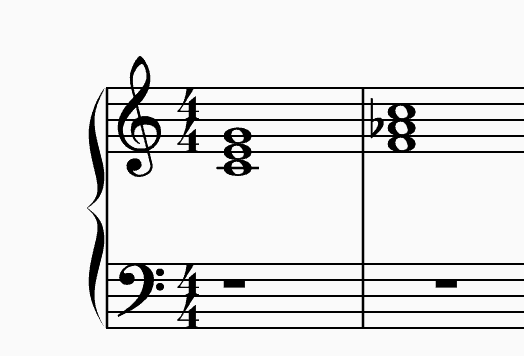
Modal interchange is another advanced technique that will make you stand out. With this method, you can ‘borrow’ a chord from another parallel key to change the color of the sound.
A lot of times these chords are taken from the minor with the same name- So songwriters who are playing in C major sometimes take from C minor, which shares many notes, but has a different key signature (more flats!).
This is technically using a bit of chromaticism, but it doesn’t feel like it, since you don’t stay in the parallel universe (erm I mean key!) for too terribly long.
For simplicities sake, try using a minor IV (Which would be fm in C major instead of F major).
Sample 16:
FAQs
How Is Model Interchange Different From Secondary Dominants?
I doubt anyone is really coming to the comments to ask this question, but I’d like to answer it anyways!
These two musical moves sound similar, but the difference is that the secondary dominant is a chord from another key that always leads to the 5 chord.
Modal interchange is broader. Some secondary dominants are modal interchange, and others aren’t.
Why Do So Many Artists Use the Same Exact Progressions?
I think that the Top 40 music of the past 3 years or so focuses more on texture and lyrical content rather than on chord progressions. There are some exceptions to the rule. What interests me is that it’s not always been this way. Back in the Carole King era, there were sus chords and 7ths out the wazoo. I personally think we should bring back the chordal spice!
What Other Ways Can I Affect the Emotion of a Song?
Aside from focusing on chord progression, I personally love to play with instrumentation, even in MIDI instruments.
Staccato double reeds like bassoons and oboes combined with clarinet almost always feel like quirky classical music or a soundtrack to a cartoon, whereas acoustic guitar doubled by mandolin can easily get you a Taylor-Swift feeling ballad in no time.
The shape of the melodies you write and how they interact with the chords also have a huge impact on the tone of the tune.
Looking to up your chord game? Check out our guides: