


The Frontman 15G comes from one of the most revered amp makers in history. The list of legendary Fender amps is quite impressive, and the Frontman 15G is worthy of the Fender brand in every sense, though it is lacking in some areas.
Fender Frontman 15G: Verdict?
This small practice amp will certainly get the job done in style. It features the classic Fender look similar to their classic amps and is compact, durable, and affordable.
It does well in the sound department as well, especially for such a small and inexpensive amplifier that employs a solid-state design. However, it lacks a key area for today’s practice amps – Bluetooth connectivity.
Build Quality (9/10)
The build quality on the Fender Frontman 15G is stellar. The covering is made of black textured vinyl with a silver grille cloth, for that classic Fender amp look.
Its enclosure is built tough and sturdy, providing a secure chassis for the insides. It also features the traditional Fender metal corners on the bottom of the enclosure, for extra protection against bumps.
Speaking of durability, this Fender amp is solid-state which provides a number of advantages. For starters, it helps keep the weight down and you won’t have to worry about replacing damaged or old tubes.
(What’s the difference between tube and solid state amps? We look at the pros and cons in Tube vs Solid State Preamps (What’s The Difference?))
This amp also features a closed-back design that some players will dislike as it makes it hard to change its speaker. However, let’s be real – it’s a practice amp! Most beginners don’t need to mess with the speaker and are just after an amp to practice with.
The Fender Frontman 15G is 13.25 x 12.5 x 7.25 inches and weighs just 15 pounds, making it easy to carry around. As expected, it is also quite easy to store and fits just about anywhere.
Features (6/10)
This amp packs 15 watts into 8 ohms, using an 8” Fender Special Design speaker, and features a 3 band EQ. As expected, it has independent treble, middle, and bass knobs.
You can choose to practice using the Normal channel for clean or the Drive channel for distortion. You get a Volume knob specifically for the Drive channel, as well as a Gain knob.
The Normal channel also has its own volume knob. The channel is selected by pressing on the drive select switch. Right below the control panel to the side, you’ll find the iconic Fender logo in full display.
For silent practice, it also comes with a ¼ inch headphone jack, as well as an RCA aux input to plug in a drum machine, CD player, or your mobile device (if you can find a compatible cable).
However, nowadays most people do not have a CD or tape player, and this is exactly why I wish Fender would re-release the Frontman 15G with Bluetooth connectivity.
Naturally, you can practice well on this amp, but it may be inconvenient to find a ⅛” to RCA cable to plug your phone into. Not to mention the fact that many phones no longer have a headphone jack to begin with.
Bluetooth is important because it has become common to practice along with YouTube and other services like Guitar Tricks and JamPlay. There are plenty of other practice amps that offer Bluetooth connectivity and Fender is likely to lose business if they cannot keep up.
Sound (7/10)
The Frontman 15G delivers good sound for a solid-state practice amp this small. Naturally, it is designed with beginners in mind, and it does a good job for that particular segment of the market.
The clean channel sounds better than the drive channel, although both get the job done considering the low price and small size. You’ll be able to hear exactly what you’re playing, and this amp can definitely help you on your path to becoming a good musician.
Thanks to its excellent clean channel, I can see this amp appealing to aspiring jazz guitarists in particular, but really players of all styles can appreciate this amp.
This little amp does take pedals well, and that’s a big advantage for anybody that requires them to practice.
This is especially useful for those that are interested in styles that feature distortion, as you can plug in your fuzz, distortion, or even overdrive pedal and the Frontman 15G will respond well.
If you’re after a cheap overdrive pedal that doesn’t compromise on sound quality, check out our roundup of the 7 best overdrive pedals under $100!
Comfort (10/10)
The Frontman 15G is as comfortable as it gets for an amp. Most of the best guitar amps are heavy beasts, for example the Roland JC-120 weighs a whopping 62 lbs!
Not only are they quite uncomfortable to carry (sometimes painful!), they also take up a lot of space in your room.
The Frontman 15G is so comfortable that you can carry it with you as you walk over to your friend’s place for a jam.
With this amp, Fender also takes into consideration the comfort of your loved ones by adding a headphone jack to the front panel. Although it is small, the Frontman 15G is still quite capable of annoying your neighbors and roommates. So the headphone output helps everyone relax!
Simply said, this amp is all about comfort and its size, weight, and portability are its best assets by far.
Wrapping Up
The Fender Frontman 15G amplifier is often included in those popular beginner guitar packages by Fender, which typically feature a Squire guitar along with other goodies.
It is important that we judge this amp as a tool for those that are starting out or those that want a very affordable amp to practice at home. It gets the job done perfectly well in that context.
However, for an amp with these traits and price, it does lack Bluetooth, which is a common and very useful feature in today’s smaller practice amps. If this isn’t important to you, you’ll be just fine with the Frontman 15G. But if you find Bluetooth essential for practice, head on over to 7 Best Portable Bluetooth Guitar Amps (Lightweight & Great Tone).

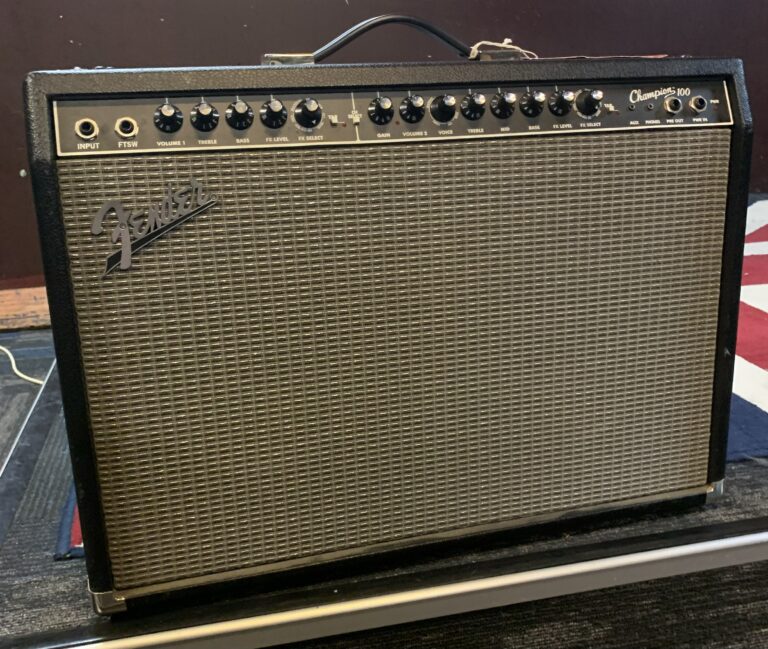


For a little amp to have for getting away from the house for what ever reason. I have mine just so I can go to friends house or on small trips. Also with my 3 pedal pedalboard.
Owned one for a while…great little amp with surprisingly shouty volume. Held its own
in band practice against louder amps/drums etc…..Nice range of tones..and also useful in studio when plug ins don’t give exact sound you want…..9/10
Quick mods to this thing. Replace the i.c.s, one for each channel. If they’re TL072 then replace with OPA2134. The overdrive is made by two led’s, and two zener diodes in the i.c.s feedback loop. The direction they face in the loop puts the four in series circuit (symmetrical clipping) Putting one of them the opposite direction or take one out and it will become asymmetrical clipping, what many call a more “tube-like distortion sag”. I never liked this solid state overdrive sound-like the speaker cloth was of aluminium foil. Asymmetric smooths things out. Leave a cap and resistor in the feedback loop and put the one end of the diodes between the i.c. signal out pin and tone circuit, then run other end of them to ground before the tone circuit- you now have hard-clipping or distortion.
These are simple mods that most could do or have done by somebody equipped with a soldering iron. There was/is a guy in Scotland that did this, and added footswitching the channels and a better reverb tank.