- Learn What Subtractive Synthesis Is And How It Works
- Dive Into The History And Evolution Of Subtractive Synthesis
- Understand The Strengths And Limitations of Subtractive Synthesis
Since its inception in the late 1950s, sound synthesis has branched into various categories, each with a unique approach to designing sound. We often see the four main types of synthesis:
- Additive
- Subtractive
- FM (Frequency Modulation)
- Wavetable.
Subtractive synthesis is one of the first and perhaps most commonly used methods of synthesis seen in modern music. Providing us with some of the most iconic sounds in music history, there is a reason why it has had such a lasting impact. Mastering subtractive synthesis should be regarded as a rite of passage for every music producer.
In this article, we will discuss what subtractive synthesis is, its origins, some of its strengths and limitations in sound design, and notable subtractive synthesizers you should be aware of.
What is Subtractive Synthesis?
Subtractive synthesis is a method of synthesis where a harmonically rich waveform is shaped by removing certain frequencies using one or more filters. It is the opposite of additive synthesis, which adds waveforms together to achieve the desired harmonic structure.
Subtractive synthesis can be likened to the act of carving a sculpture from a piece of wood. The waveforms in subtractive synths are either sine, triangle, square, or sawtooth in shape. These waveforms are produced by an oscillator (or two in some cases) and then passed through a filter in the first subtraction phase.

Subtractive synthesis can be used to produce a wide variety of sounds. However, its tonal characteristics are often associated with early analog synths and can be described as classic, warm, vintage, and synthetic.
The Origins of Subtractive Synthesis
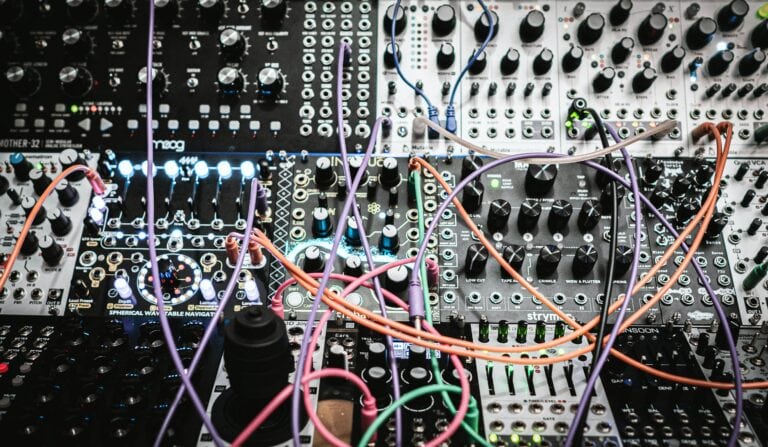
The journey of sound synthesis began when German engineer Harald Bode, introduced the first modular synthesizer in 1959. Many of the features we see in synths today represent the original components in these early modular synthesizers. Individual modules were patched in sequence via cables, which allowed engineers to shape an audio signal in multiple stages.
Subtractive synthesis began with the application of a VCF component (Voltage Controlled Filter) to a signal, followed by a VCA (Voltage Controlled Amplifier), which is controlled by the following Envelope Generator component. The signal was then often manipulated further using an LFO or Low-Frequency Oscillator. This component chain provided the blueprint from which the first subtractive synthesizers were designed.
💡Fun Fact: Subtractive synthesis was initially created in the ’60s for producers to emulate the sounds of acoustic instruments without needing to source musicians.
This opened up a whole new world of potential for music producers. As analog synthesizers grew in popularity, so did their application in modern music. Through the 60’s and 70’s, a new era of music emerged by creating sounds that had not yet been possible.
Analog synths that applied subtractive methods like the Moog Minimoog, Arp Odyssey, Roland MKS-50, and Oberheim OB-X forged the way for modern synthesizers and laid the foundations for many of today’s digital synthesizers.
Subtractive synthesizers influenced various genres, from Jazz and Rock to Funk, Disco, Pop, Hip Hop, and beyond. Artists like Kraftwerk, Pink Floyd, The Bee Gees, Stevie Wonder, and ABBA pioneered the sound, while artists like Michael Jackson, Future Sound Of London, and Prodigy helped to transform the sound through the decades. Now used by artists like Tame Impala and Bonobo, subtractive synthesis has stood the test of time well.
How Does Subtractive Synthesis Work?
Now that we understand the foundational components of subtractive synthesis let’s look at how they work.
- First, the oscillator generates a waveform with a sine, triangle, square, or sawtooth shape.
- This signal then passes through the filter, which removes frequencies specified by a selection of parameters. The filter stage is where subtractive synthesis earned its name and allows for precise sound sculpting.
The basic filter parameters are cut-off frequency, resonance, curve or slope, and overall shape. Common filter shapes are Low Pass (High Cut), High Pass (Low Cut), Bandpass, and Notch, but it is not uncommon to apply a combination of audio filter types.
Low Pass filters allow the lower frequencies to remain unfiltered and attenuate the highs, while High Pass filters do the opposite. Band Pass filters isolate a specified frequency spectrum while cutting the highs and lows. Notch filters work in reverse to a Band Pass, cutting an isolated frequency range and leaving the highs and lows unfiltered.

The curve or slope of a filter determines how abruptly the filter attenuates the frequencies specified by the cut-off. A steep curve removes frequencies abruptly, whereas smooth curves allow for a subtler blending out of frequencies. The cut-off determines at which frequency the filter will act, and the resonance can be used to boost frequencies at the cut-off point, giving them more presence.

The Amplifier with an ADSR Envelope follows the filter phase. In this stage, we can alter the sound signal over time using the envelope’s Attack, Decay, Sustain, and Release parameters, hence where it gets its name. Adjusting the envelope settings allows us to create sounds with fast transients like drums and synth stabs or slower transients like pads and swelling leads. Finally, the LFO allows us to modulate almost any parameter within the synthesizer by assigning it to an oscillator that plays below our perceivable frequency (20Hz).
Since the beginning of modular synthesis, this particular signal flow gave subtractive synthesizers their unique sound and paved the way for those that followed.
Related: Modular Synthesis Basics (How It Works And How To Dive In).
Pros & Cons Of Subtractive Synthesis
It’s a little awkward to objectively classify ‘pros’ and ‘cons’ of any synthesis type, as they are merely different ways of sculpting sound. However, it is possible to generalize some of the hallmark features and limitations of subtractive synthesis.
| Pros Of Subtractive Synthesis | Cons Of Subtractive Synthesis |
| Workflow simplicity | Predictability |
| Precision | |
| Flexibility |
Why Use Subtractive Synthesis?
✔ Workflow Simplicity
Subtractive synthesis is perhaps the most straightforward kind. Because the sound is carved from an initial waveform, there are few surprises about how a sound will react at each synthesis stage.
✔ Precision
The outcome is somewhat predictable and relatively easy to manipulate with precision. In this sense, subtractive synthesis can often provide the most direct route to achieving a desired sound compared to additive or FM synthesis.
✔ Flexibility
It is also one of the most common types of synthesis. Therefore, we can use it to recreate many sounds we hear in popular electronic music. Subtractive synthesis has the power to imitate acoustic instruments as well as create a huge variety of weird and wonderful synthetic sounds. Plus, who wouldn’t want to throw it back to the ’70s and lay down some epic disco-inspired, vintage electro grooves now and then?
Limitations Of Subtractive Synthesis
It’s undeniable that subtractive synthesizers hold a lot of creative potential. However, they are not without their limitations.
Predictability
With a relatively straightforward synthesis style, you won’t be able to create the same massive, morphing, brain-warping sounds that you might be able to with wavetable synthesis. The outcome is much more predictable, which can sometimes be great and hindering at others.
Subtractive synthesis may not hold all the answers when designing the most complex or expansive sounds, but its creative power and useability cannot be denied.
Examples Of Subtractive Synthesizers
Classic Subtractive Synthesizers
Notable, classic subtractive synthesizers include:
- Moog Minimoog (1970)
- Roland TB-303 (1982)
- ARP Odyssey (1972)
- KORG MS-20 (1978)
- Sequential Circuits Prophet-5 (1978)
Modern Subtractive Synthesizers
Modern subtractive synthesizers and VST plugins include:
- Native Instruments Massive (2007)
- Arturia Minibrute (2012)
- Roland System-8 (2016)
- U-He Diva (2011)
- Novation Summit (2019)
Before You Go…
Subtractive synthesis provides a beautiful, nostalgic, and streamlined approach to sound design. However, that only scratches the surface. Why not also brush up your knowledge on: