- Looking for a way to replicate the beefy low end of a 7-string, but with a regular guitar?
- Our illustrated guide shows you 4 methods to get there.
If you’re a 6-string guitar owner, you’ll be pleased to know that there are several ways to make your guitar sound like it’s carrying 7-strings, some of which are pretty straightforward.
Here are four methods you can use to make your 6-string sound like a 7-string:

- Tune Every String Down
- Tune Your Low E String Down To B
- Add An Extra Octave Note
- Use A Pitch Shifter Pedal
Method 1: Tune Every String Down

The easiest way to replicate a 7-string guitar is to tune your entire 6-string guitar down to B-E-A-D-G-B.
By doing so, you will be able to copy the tunings of a 7-string, but without the use of the top string that is tuned to E.
This can be a great option if you’re looking for extra low-end oomph, and aren’t worried about losing access to a high E note.
For this technique to work properly and have your guitar stay in tune, ensure you use heavier gauge strings.
It also helps if you’re using a baritone guitar here, too. For a deeper dive, check out our comparison between Baritone vs. 7-string guitars.
Tip! Be prepared to get used to the changes in intervals, because your E note is now played on the second string. You will be using the same intervals as standard tuning, but playing them a string higher. Think of it as playing a 7-string guitar, but you’ve dropped the top (thinnest) string.
Method 2: Tune Your Low E String Down To B
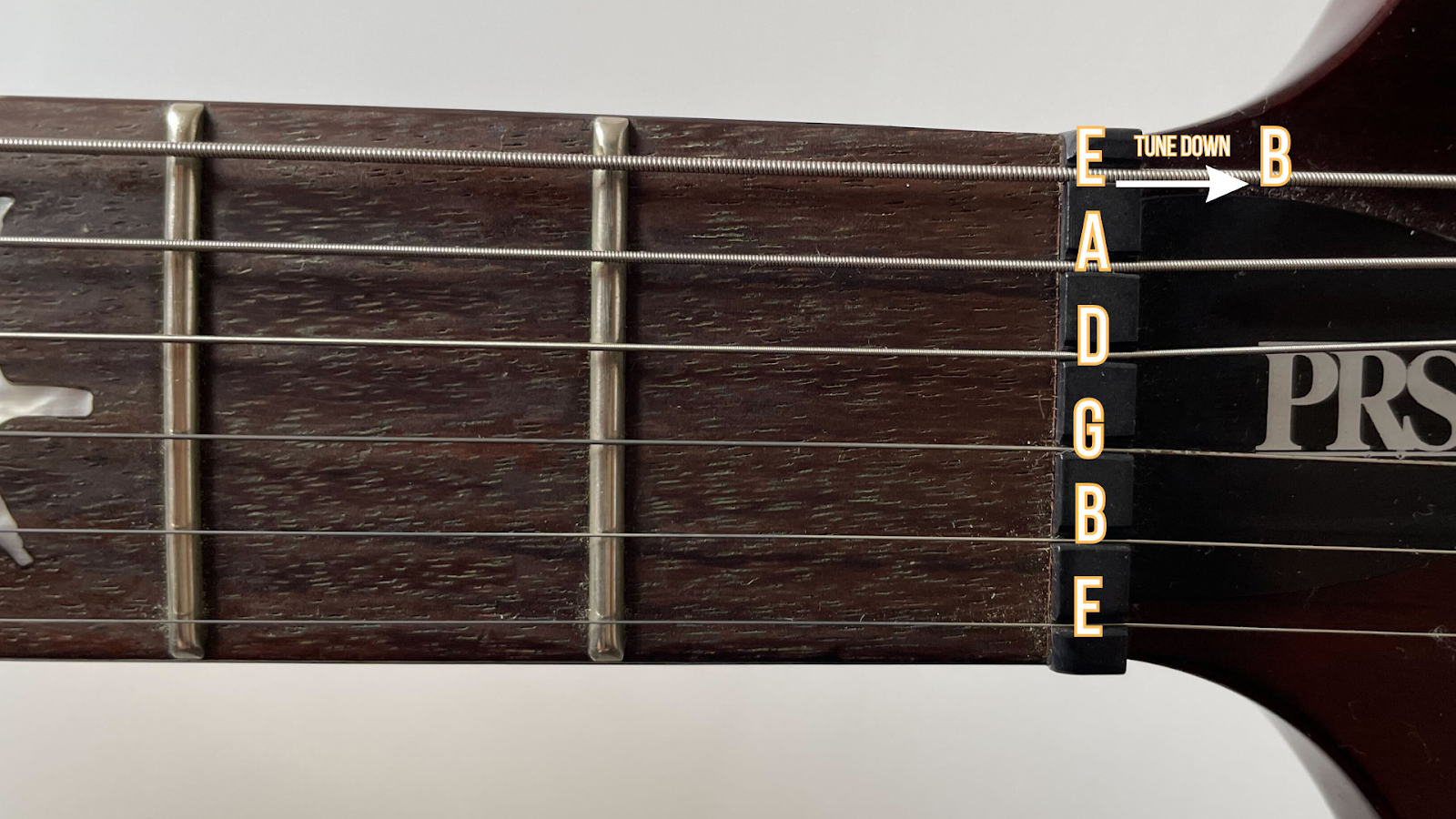
This is the easiest method, as it just involves tuning your low E string down to a B note.
There are some things to consider if you decide to do this. First, you won’t be able to play standard power or bar chords like you usually would. Or at least not with the lowest string included (you’ll end up with a dissonant mess).
This is because your normal finger position in standard tuning now incorporates an entirely different note. For example, if you were to fret an E power chord in standard tuning, you would be playing an E and an A. However, by tuning your bottom string to B and following the same fingering, you would be playing a B and an A.
Tip! One way around this is to use the single-string method and avoid power chords altogether, which can be a lot of fun to play around with. Still, if you are looking to jam along to one of your favorite songs that uses a 7-string guitar, you won’t be able to replicate it perfectly.
Method 3: Add An Extra Octave Note

This is a really simple trick that doesn’t require any detuning whatsoever. All you need to do is play a power chord with the root note on the A string and then introduce an extra, lower octave of the fifth note.
Let’s take a C power chord as an example. You’ll play the third fret of the A string (C), combined with the fifth fret of the D string (G). Now incorporate the third fret of the low E string (also G). This results in a droning, powerful sound, quite contrasting to a typical power chord.
The reason this creates a 7-string-esque sound is that you are effectively reproducing what a 7-string guitar sounds like but in a higher register. This is because the way the strings are tuned is in the same intervals as they are on a 7 string. They are just higher in pitch.
So, while this won’t give you a growling low end that many 7-string players desire, it’ll trick your ears and make you feel like you are listening to a 7-string.
Method 4: Use A Pitch Shifter Pedal
This option requires a bit of financial outlay. Still, it can be a great way of replicating a 7-string guitar that is convenient (particularly if you’re playing live or want to make a quick switch without swapping guitars or completely detuning your 6-string).
A pitch shifter pedal will take the incoming signal from your guitar, and pitch down or up to a designated note. In this case, you could pick up a Whammy pedal, or something similar, and set it to detune your guitar. A significant benefit of this is you don’t need to worry about your guitar’s scale length or playing with floppy strings because you’ll still have the feeling of playing the guitar in standard tuning, but what you’ll hear is that of a much lower register.
A downside is you’ll need to make sure the pitch shifter you choose has excellent tracking (meaning, it can accurately pick up the note you’re playing and reproduce this at a lower tone without sounding glitchy).
Pitch shifters are often more reliable when single-string riffing, so keep that in mind if you’re more inclined to play bar chords or combinations of notes.
FAQ
Do You Need Thicker Strings For A Low Tuning?
Ideally, yes, you want to be using a thicker gauge if you want to detune your guitar heavily. Not only does the thickness mean you’ll be able to hold the tuning better, but you’ll also get a darker tone, which can be much more suitable when playing low tunings.
There are sets you can buy, such as Ernie Ball Hybrids, that offer a thicker gauge on your lower strings while retaining a thinner gauge on the highs. This can work well if you’re only tuning the bottom string down, but I’d recommend, at the very least, an .11 gauge.
If you intend to detune the entire guitar, use a complete set of thicker gauges.