- What is the difference between tube vs solid-state preamps?
- What are the tonal differences?
- Is one better than the other?

Tube Vs Solid-State Preamps
A common debate you’ll no doubt have heard between audiophiles is tube vs solid state – which is better?
While we’re not going to get into ‘which is better’ in this piece (as it’s entirely subjective), we will take you through a guide on the difference between the two.
Covering The Basics: Preamps
A preamp is a piece of equipment that brings the level of a microphone or instrument up to a point where it is recordable. They can be found in mixing consoles, outboard equipment racks, and even the interface you use at home.
Let it be known that no two preamps are the same.
This is why you’ll usually find a selection in any recording studio. A good studio engineer will know the intricacies of each at their disposal. Each one will have a slightly different tone and add a different level of ‘coloration’ to the sound.
A Brief History
Nowadays, we are used to using electrical items daily, most of which use transistors (i.e., solid-state) and are small, compact, and often portable.
However, before the invention of transistors, tubes were used in items such as guitar amps and computers.
The earlier incarnation and uses of tubes are understandably more primitive than we have today, but how they are mainly used remains the same.
The original invention of tubes came from a phenomenon known as thermionic emission.
What Is Thermionic Emission?
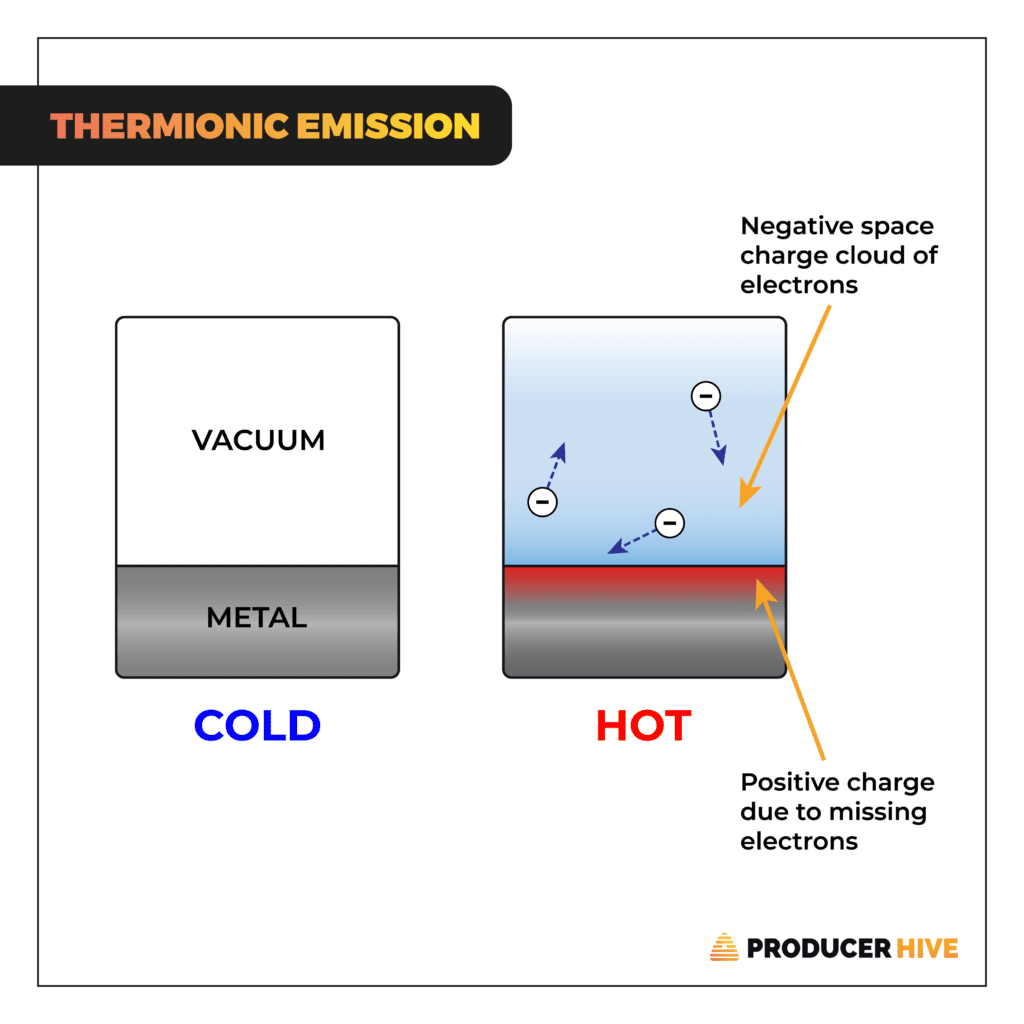
In a nutshell, this is the process whereby a heated piece of metal releases electrons. If a cathode (a device from which current will flow out) is heated, it will give off electrons through thermionic emission. If an anode (a device that will receive current, sometimes called a plate) has a positive voltage applied, it will attract these electrons.
The electrons can flow freely without air resistance by placing these inside a vacuum tube.
How This Applies To Preamps
Up until the 1940s, most amplifiers used tubes in this way. Around this time, however, transistors were invented, which became much more affordable, and were much less fragile than tubes.
A transistor becomes an amplifier by helping to raise the strength of a weak signal. Unsurprisingly one of the first uses of a transistor was in hearing aids, amplifying the incoming signal by this method to produce a much larger signal for the user to hear.
The idea of a transistor is arguably more complex than that of a tube, but in very brief terms, a transistor works by taking a small current at one end (the input) and producing a much larger current (the output).
The transistor is a current booster, hence the term ‘amplifier.’ One great thing about transistors is that they require much less power than a tube.
Transistors are much smaller and less fragile than tubes, so it is easy to see why they are now more common in electrical items than tubes. Can you imagine having to run your computer at home with a set of tubes?!
Tube vs Solid State: Tonal Differences
We know, in music, that even subtle differences can cause big changes, whether the angle of a microphone’s placement or the type of wood a guitar is made from. So naturally, a tube preamp will have different qualities to a solid-state amp with transistors.
A tube preamp tends to have warmth and smoothness that a solid state often lacks.
Because of how they work, driving the tubes creates a subtle but smooth distortion adding a pleasing character to the tone. This doesn’t necessarily constitute distortion in the sense of ‘overdrive’ but rather more color or character.
There is a more scientific explanation for why a driven tube preamp is more pleasing than the sound of solid-state transistors.
As a tube creates distortion, it produces harmonics known as ‘even harmonics.’ Essentially, these tones are the same note but are produced higher in octaves. This is why a tube amplifier is typically said to sound better because the harmonics it produces are much more pleasing to the user’s ear.
If you’d like to read up on odd vs even harmonics, check out this post we wrote.
Now if we’re talking about mic pre-amps, it can often be the case that the difference is subtle but will add character to the recording that, when placed with other instruments, causes it to sound better and balanced.
If we look at high-gain guitar amps, ‘driving’ (or increasing the input to) the tubes creates a lush distortion that many regard as superior due to how the tubes behave.
The downside of this, however, is that tube amps don’t respond or perform as well at lower volumes, meaning for the bedroom guitarist, they may not be the most suitable option if you’re looking for tonal quality.
The characteristics of tubes will also change depending on their temperature, with tube pre-amps generally sounding a little better when left on to warm up.
In contrast, a solid-state pre-amp tends to create odd harmonics, creating a sense of dissonance that is less pleasing to the ear.
That said, solid-state pre-amps tend to have a more ‘transparent’ sound in general, so whilst there may be some odd harmonics present, the sound will generally have less coloration than a tube pre-amp and can handle higher gain levels without being pushed to distortion.
So, what does this all mean? Well, a solid-state preamp could be a great choice if you want to capture the natural sound of your source.
Tube vs Solid State: Pros and Cons
As with most musical equipment, there is no right or wrong. Both tube and solid state offer different characteristics. If you’re thinking about investing in a good quality pre-amp, weigh up the pros and cons first:
Tube
Pros
- Warm tonal quality
- Creates a lush distorted sound that adds character
- Emphasizes even harmonics which are pleasing to the ear
Cons
- Tubes require more maintenance and will eventually need replacing
- Tubes may not be as suitable as a solid state pre-amp for instruments such as drums that have powerful transients and quick attack
- Tube tone changes over time, and use
Solid State
Pros
- Clean sounding with very little distortion
- Ability to handle higher gain signals
- More suited to instruments such as drums and often acoustic guitar
- Tend to be cheaper than tube pre-amps.
Cons
- Can produce odd harmonics which aren’t as pleasing as tubes to the ear
- Can sound harsh on certain instruments
- Cheaper pre-amps often don’t sound great.
If you’re still unsure of the tonal characteristics of the two, you’ll find plenty of comparisons online or on Youtube. We’d recommend checking out the Universal Audio Solo/610 for a classic tube sound or the Neve Portico 5012 for solid state.
Become A Master Of Overdrive
Check out this brand-new course from Noiselab!
Lesson topics include:
- Overdrive and Circuit Drive
- Saturator and Waveshaping
- 808 Bass Saturation
- Saturation and Drive in Synthesis
- Echo Overdrive and Spatialization
- Filtered Saturation
- Controlling Dynamics
- Vocal Enhancement