- Want to spruce up and experiment with your guitar playing?
- Why not try some slick accessories?
- Read on to get a better idea of what’s available.
- Bear in mind some of these are mandatory…
As you go about finding your groove as a guitarist, there are many ways that you can jazz it up. Plus, it’s just good to try different things, as it’s such a versatile instrument, made more so with some creative tools. That said, some guitar accessories have to be had. For instance, an electric guitar isn’t too electric without the right lead cables…
In this article, we’ll first look at the essential guitar accessories in some depth and then take a glimpse at others you can add to your roster if you so choose. Let’s jam!
Mandatory Guitar Accessories
Strings

A guitar without strings is just a lovely piece of wood. So, think about what genres you are playing and what styles you are aiming for. Pick whether you want nylon, steel, Fender, or Ernie Ball based on this. Getting two packs at first is recommended so you have a backup set there for the future.
Another important reason to do this is to be prepared for the future. While your new guitar may have come pre-strung and even pre-tuned, a day will arrive when you have to change your strings, which involves the autonomy of picking your strings. It’s important to be able to change your strings. It makes you a more capable and prepared player.
Tuners

Tuners are arguably very mandatory, especially if you are playing gigs often or are planning to one day. Of course, you can learn to tune your electric or acoustic guitar by ear. If you’re a natural, you might be able to do that.
But in many cases, or if you plan on playing music with others, you need to be in sync, which tuners will help you accomplish. But even in this category, there is a broad range of options. We’ve listed a few to give you an idea of what’s available.
Something to think about as you browse. When shopping for tuners, why not consider the aesthetic advantages as well as the practical ones? Because a practical set-up is a slick set-up.
Pedal Tuners
Pedals have become a staple of musicianship since the first one came out in the mid-1940s. Now, the market is swarming with them. Many live musicians play with pedal rigs; a tuner pedal is a great addition. It can work as a killswitch and plugs straight in through the jack socket, creating a stable connection to read notes. They’re easy, efficient, and are designed to be simple.
Clip-On Tuners
These are generally cheaper and more convenient. Simply clip it onto your headstock and play the notes. The downside is that they use vibrations to detect which notes are hit, meaning that their note readings are not as accurate in loud environments (such as gigs).
Polyphonic Tuners
These boys are smart. Relatively new to the market, polyphonic tuners tune your instrument in a singular strum. They’re closer to pedal tuners in terms of pricing and are generally more complex. But they’re used mainly by sound technicians for complex instruments.
Sound Hole Tuners
Pedals, clip-ons, and polyphonic tuners are good equipment, but you must pack them, purchase additional patch cables, and not leave them behind. Some musicians solve this with pedal boards, which keep all your pedals in one place – it’s just an extra bag to carry.
Acoustic musicians often turn to sound hole tuners to avoid this. These can be built permanently into an acoustic guitar and are great for silent running.
Plectrums

There are a few things to consider when it comes to guitar picks. The first is what instrument you’re playing. A bass player may prefer a different guitar accessory to an acoustic guitar player. Many bassists that this writer knows use thick picks, whereas acoustic strummers are more likely to use picks much less than a millimeter thick.
Genre is another question. A player who wants to do tremolo picking will need a pick suitable for the task, whereas somebody who wants to play unplugged country music may prefer a 0.5mm plectrum for flexibility.
How To Select A Plectrum
That’s a whole article in itself. Fortunately, I wrote this article that covers everything you need to know about choosing a bass pick. I’ll get round to writing one exclusively for guitar players, too, eventually!
Amp
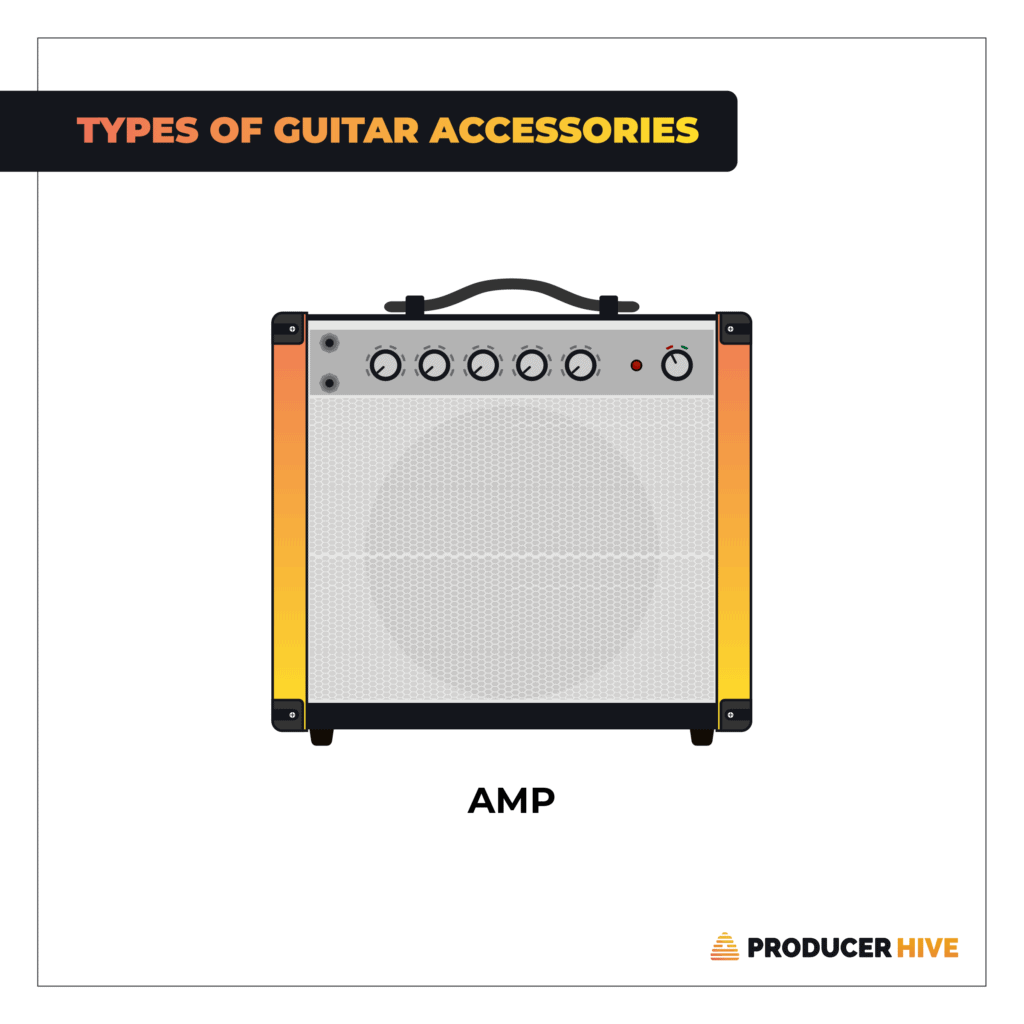
All electric guitars require an amp. It doesn’t need to be big (at first), and it doesn’t need to be flashy. But you do need different brands depending on genre preference. If you plan to play blues or rock, look at Fender products.
Marshall, Laney, or Peavey are more appropriate if you want heavy metal. As a lifelong metal guitarist, I heavily vouch for and endorse Marshall. BUT… the world is your oyster, and part of the fun is finding your own guitar tone, not just copying what everyone else is doing.
Amp debates can get quite heady at times. If you’re new to them, it’s worth checking out these articles:
Leads & cables
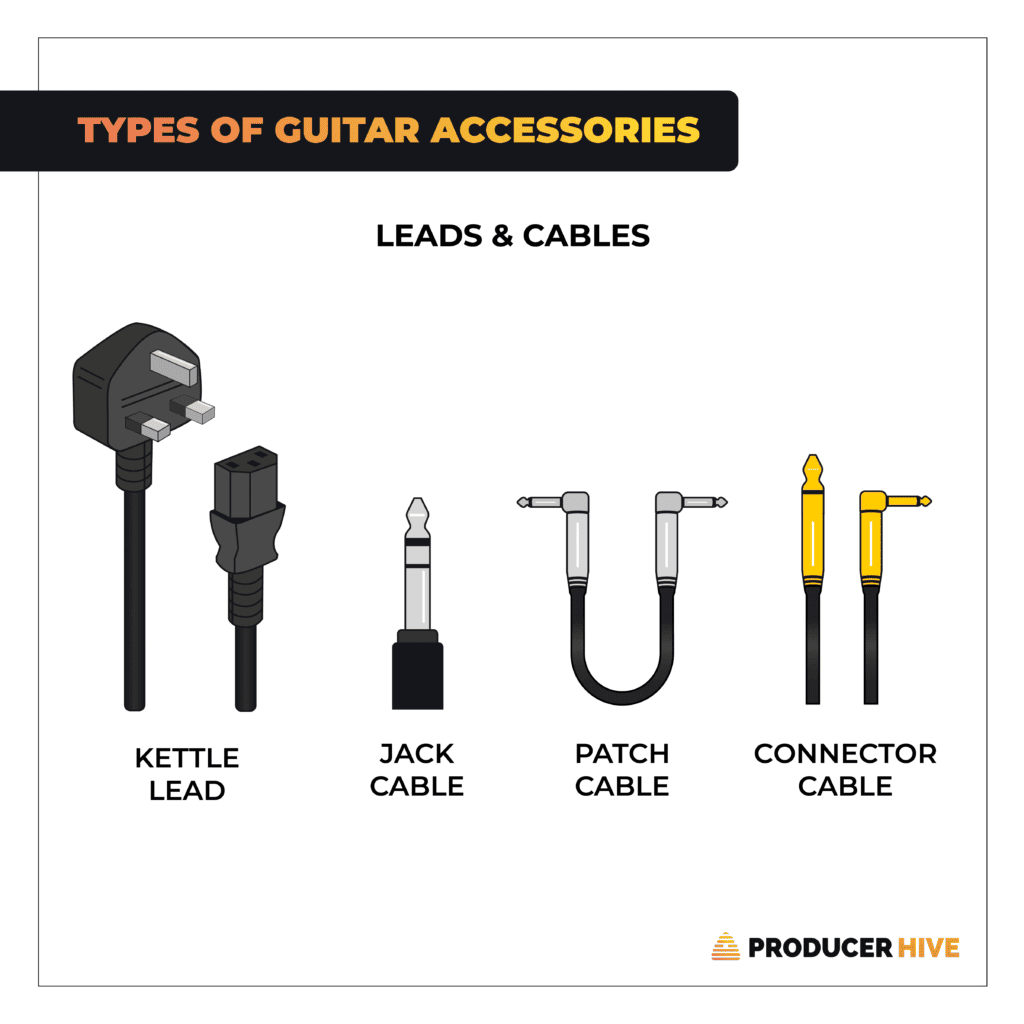
If you play electric guitar long enough, you’ll wonder what all the cables are called. People often use ‘jack cable,’ ‘patch cable,’ and ‘connector cable’ interchangeably, but they’re not and shouldn’t be.
If you play live and are tasked with connecting an amp head to a cab, you don’t want to use a bass jack lead. In the worst-case scenario, it can cause an explosion. In the spirit of keeping your gear intact, here is a brief rundown:
- Jack Cable: The standard guitar accessory that connects the guitar and amp.
- Patch Cable: A small cable used to connect one pedal to another, creating the rig.
- Connector Cable: The cable that connects your amp head to its designated cab.
- Kettle Lead: The pronged plug that goes into the main socket, giving power to large amps. They are also known as IEC cables or power leads.
You only need a single jack cable to plug a guitar into an amp. Get a tuner pedal (or any pedal), and you’ll need two jack cables. Add a second pedal, and you need two jack cables, a single patch cable, etc.
Cables can also come in TRS or TS varieties.
Guitar Straps
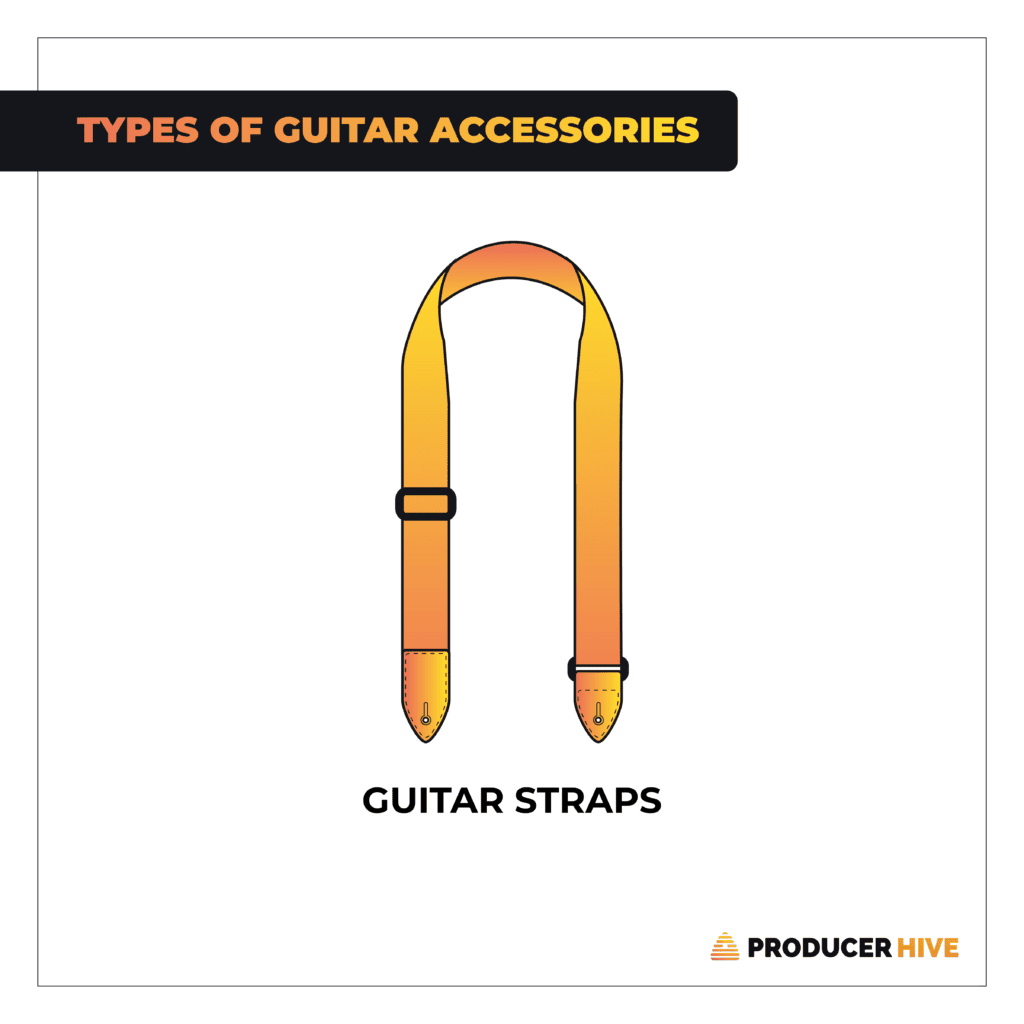
Unless you’re playing acoustic and therefore constantly sitting – though, many acoustic artists play standing – then you will need a strap. At first, the one that comes with the guitar will do. But be aware of the great options, both stylistically and ergonomically, available.
Other Accessories (Not Essential)
Capos

A capo is a small device that clips onto your fretboard, shortening the length of the strings. You can change the guitar’s tuning without re-tuning it and scale a different breadth of notes in the process.
There are many different types of capo, each with its own mechanics. But generally, the G7th Capo and Trigger Capo are the most highly recommended, especially for beginners.
The G7th uses a pressure system that you squeeze to adjust, and the Trigger Capo works with a spring-loaded mechanic, which clamps down on the fretboard. The latter is, coincidentally, the most popular.
Other capos, such as Cradle Capos, Strap Capos, and Toggle Capos, have different features. The first uses a long bar to affirm tuning accuracy, whereas the Toggle Capo uses an adjustable strap to hold tension. If you are interested in them, shop around and see what feels best!
Whammy Bars
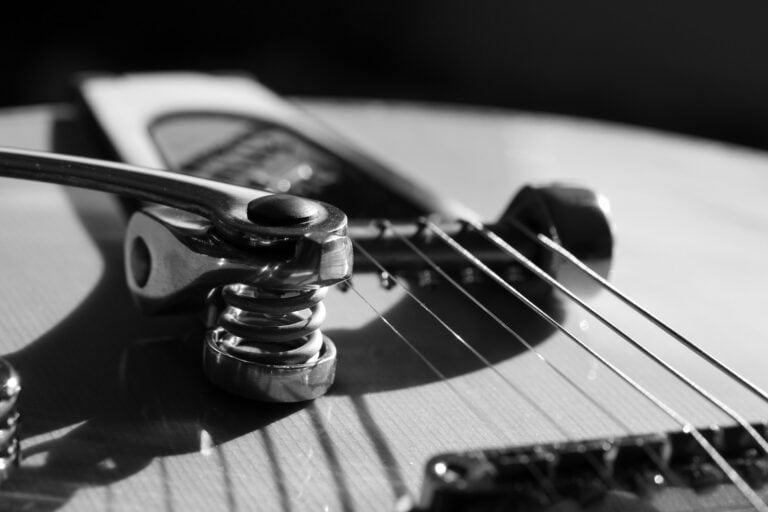
Most guitars come with this accessory. Also referred to as a wiggle stick, vibrato, tremolo, and vibrato, the whammy bar is a metal arm that attaches to the bridge of your guitar so that it can lift the bridge, creating a variety of cool sounds like motorcycle revving, dives, and flutters. The only kicker is that it quickly puts your guitar out of tune. Practice and a deft hand will solve this.
Guitar Pedals
We live in a golden age where guitar pedals are aplenty, and there’s something to fit everyone’s budget.
While not essential (many amps now come packed with their own set of effects), guitar pedals open up a world of tone shaping possibilities.
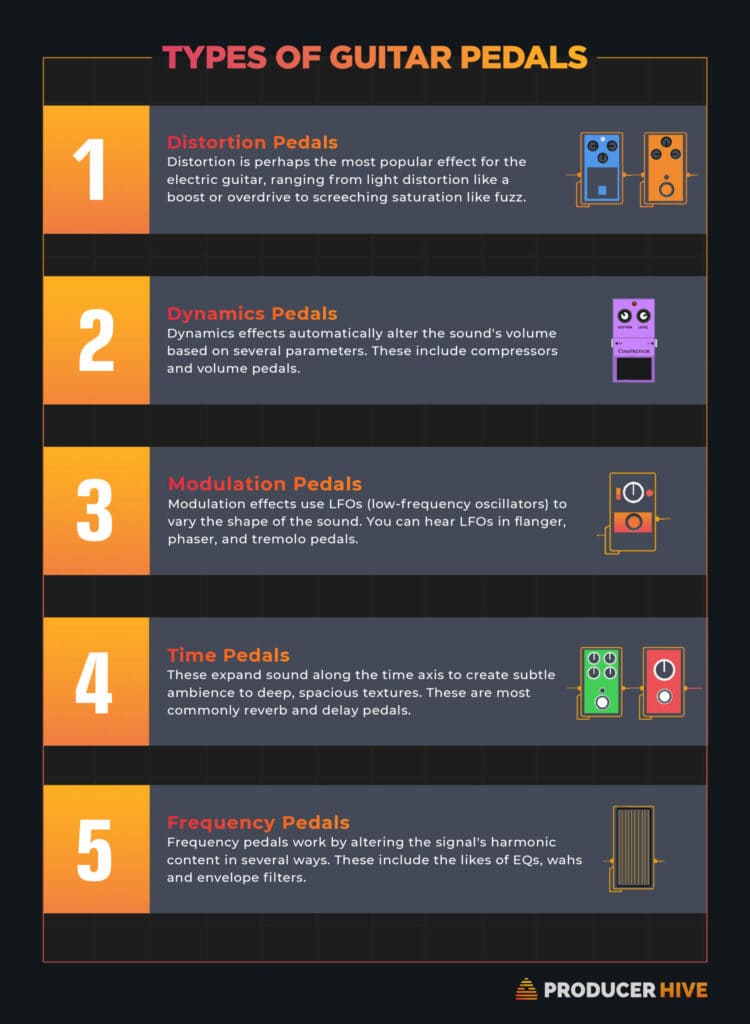
Guitar pedals are a pretty extensive topic, so if you’d like to read up more about them, check out our guide to all the different types of guitar pedals.
Ebow
An Ebow handheld device interacts with your guitar strings and pickups. It makes a synth-like sound that sounds soaring and can sustain notes substantially. Blondie used it on a couple of tracks, too.
Guitar Stands and wall mounts
Guitar stands are used to stand your guitar. There are many types, some of which feature the ability to stand three or four guitars at once. Equally, wall mounts are available and fixed into the wall so your collection can sparkle from there.
Guitar Slide
The guitar slide is a device that goes on your finger and allows you to ascend dramatically. It’s commonly used in blues and country music.
Pedalboard
Pedalboards are used to keep your pedal rig in one place. If you play live, you can pack it up and carry it home without the need to re-structure it next time.
Pedal Power Supply
You can power your pedals with batteries, but if you have a power supply, you need a mains socket. This stops you from having to buy batteries constantly.
Locking Tuners
These are used to make your guitar tune more stable. So, if you do a lot of bends, whammy-bar maneuvers, and the like, then this bit of kit maintains the stability.
Wrapping Up
Getting a basic guitar set-up is the best thing you can do as a beginner player. That’s because your style and abilities have not yet reached the stage where you need the more niche stuff like flanger pedals and other wild sounds.
But that will come with time. First, you need strings, leads, a strap, and a plectrum. That’s enough to function for now and exercise your creative juices.
For more tips and tricks to aid your journey as a musician, check out our resources on all things electric guitar!