- Learn how to build and use a Neapolitan chord
- Discover the history behind the Neapolitan chord
- Hear the Neapolitan chord in action in a few different examples
This article will discuss the history of and give a little theory behind one of the compositional tools that has been a mainstay of Western Art Music from the 18th century to the present day: the Neapolitan Chord.
The Neapolitan chord is a major triad built on the flattened scale degree 2 (or supertonic) of a major or minor scale.
In Western Art Music, this chord is most typically found in the first inversion and is thus referred to as a Neapolitan Sixth.
Origins Of The Neapolitan Chord
The Neapolitan chord is named after the Neapolitan School, a loose grouping of composers writing opera out of Naples in the 18th century. Francesco Provenzale is widely considered to be the school’s founder, though Alessandro Scarlatti is the best-known.
Though the Neapolitan chord is named after the Neapolitan School and was undoubtedly used prominently in the 18th-century Baroque operas written by members of the Neapolitan School, composers were using the chord before the acknowledged start of the school as well, particularly Arcangelo Corelli and Henry Purcell.
How To Build A Neapolitan Chord
In this section, we will go through each of the concepts you will need for the process of building a Neapolitan chord to make sense.
We will review the major and minor scales, diatonicism, and triads.
The Major Scale
The major scale is, first and foremost, a pattern of intervals. It can begin on any of the twelve pitches of the octave, and it ends on its octave equivalent, one octave above where it begins.
From the first pitch to the last pitch, it includes every note name of the musical alphabet. For example, a major scale built on D includes D, E, F#, G, A, B, C#, and D.
The pattern of intervals is a series of whole steps and half steps: D to E is a whole step, E to F# is another whole step, F# to G is a half step, G to A, A to B, and B to C# are each whole steps, and C# to D is a half step.
Thus, the pattern is W-W-h-W-W-W-h, which can be superimposed on any starting pitch to generate a new major scale.


The Minor Scale
The minor scale is essentially the same as starting the major scale’s pattern of intervals on scale degree 6.
Thus, instead of a pattern of W-W-h-W-W-W-h, the minor scale is a pattern of W-h-W-W-h-W-W.

Diatonicism
Diatonicism refers to music that is composed using the pitches of a scale. A diatonic melody, for example, would avoid any pitches that are not part of the scale in which the composer is working.
We will review triads next, and diatonic triads are the triads built using only the pitches of the scale. Not to give too much away, but the Neapolitan chord is specifically not a diatonic triad.
Triads
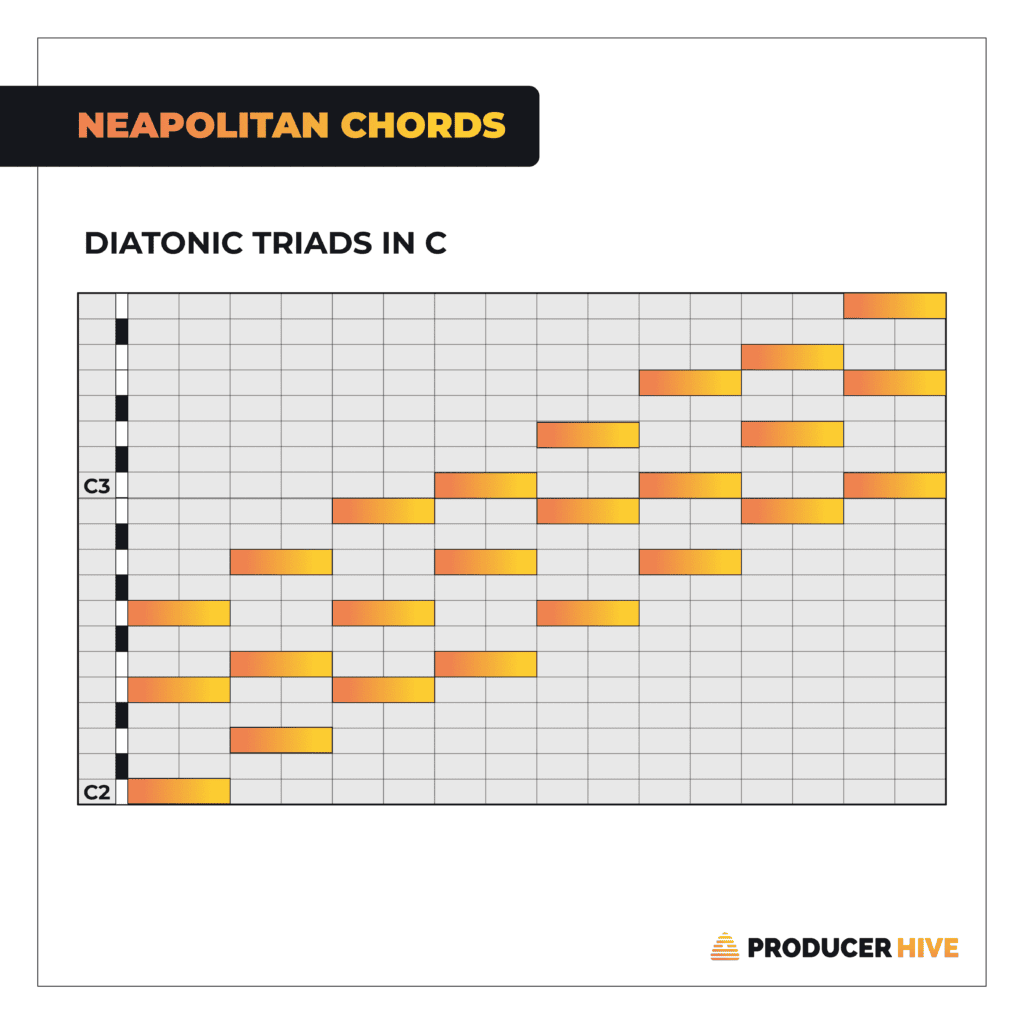
Triads are the basis of harmony in Western Art Music and all of the forms of popular music that it has influenced. Like the major scale, they are basically a collection of intervals. All triads consist of a root, a third, and a fifth.
The root is the starting pitch (after which the triad will be named), and the third and fifth essentially involve stacking two thirds on top of the root.
Two types of thirds will be important for building the triads we discuss in this article: the minor third is composed of three half steps (also known as semitones), whereas the major third is composed of four semitones.

For this article, we just need to know how to build a major triad, but in the interest of being well-rounded musicians, we will review the minor triad as well.
The major triad consists of a major third between the root and the third and a minor third between the third and the fifth.
The minor triad reverses these: the third between the root and the third is minor, and the third between the third and the fifth is major.
It is worth noting that the outside interval in each case is equivalent to seven semitones (a major third combined with a minor third): seven semitones is a perfect fifth.
Building A Neapolitan Chord: A Step-By-Step Guide
Now that we have that review out of the way, let’s build this chord:
- The root of a Neapolitan chord is a flattened (lowered by one semitone) scale degree 2. To return to an example in D Major, the flattened scale degree 2 would be E-flat.
- The Neapolitan chord is a major triad, so add a major third above the root. A major third above E-flat is G.
- The fifth of any major or minor triad is a perfect fifth above the root, so add a perfect fifth above E-flat (which is B-flat, another non-diatonic pitch within D major, but not within D minor).

How To Use A Neapolitan Chord
The Neapolitan chord functions like any other pre-dominant chord in that it both delays and prepares for the arrival of a dominant-function chord.
Within a minor key, it differs only by one semitone from the sub-dominant (iv) chord, which makes it an obvious choice for interesting and relatively parsimonious voice leading when delaying the arrival of the dominant triad from the sub-dominant triad, especially if it is in first inversion (meaning that the third is spelled as the lower note instead of the root – for more on inversions, check out this article).
Examples Of Neapolitan Chords In Action
Thanks to Robert Hutchinson of the University of Puget Sound for this next section.
The progression at the opening of the breathtakingly beautiful Moonlight Sonata (Beethoven) includes a Neapolitan sixth chord in between a VI chord and a V7, which makes for excellent parsimonious voice leading from a tonic chord to an extended pre-dominant area on the path to the dominant 7th chord.
Follow the movement in the left hand (the bass line), and you will hear a whole note octave, another whole note octave, and then the half-note root of a VI chord introduces some drama that is significantly heightened by the introduction of the next half-note, which is the third of that Neapolitan sixth chord, easily the most poignant bit of harmonic motion in the early part of the piece.

A similarly poignant moment occurs in the Raiders March from John Williams’ Raiders of the Lost Ark Soundtrack.
The approach is different, from a tonic directly to the Neapolitan chord in root position, but it conveys a similar sense of “time is up, we are going straight from this last pre-dominant moment to a dominant chord, and then we’ll see where we go from there.”
That Neapolitan chord is first introduced at 0:17 in the video below.
Another piece of film music with a root position Neapolitan chord is the main theme from the J.J. Abrams Star Trek films (hear the Neapolitan chord at 6:34). When used well (as it is here), the Neapolitan chord can feel like the most important moment in a chord progression.
Typically, the climax of a chord progression has something to do with the dominant function chord, but in this case, the pre-dominant function Neapolitan chord is the eyebrow-raising, goosebump-causing moment, perhaps because it exists in the moment one might expect to hear a dominant arrive, but instead another pre-dominant function chord delays it.
Wrapping Up
As I suggested in the introduction, you have certainly heard the Neapolitan chord before, and it would be reasonable to assume you have stumbled upon it while playing or writing, too. My job in this article was to put a name to the sound, show you how to build it, and show you how you might use it in the future.