After spending a few months with the VAD507, I break down my full thoughts on the kit – from the quality of the pads, to the cymbals, hardware and the TD-27 module.
Although much of the Roland VAD 507 is a copy of the previous VAD506 model, there are some significant upgrades (check out our direct comparison of the Roland VAD 506 vs 507 here).
Roland spearheads E-drum (or, as they call it, ‘V-Drums’) technology, and they are, in my opinion, the best in the industry. So, as you can imagine, this upper mid-tier kit comes with a fairly hefty price tag…but you’re never going to get a budget kit with this kind of detail.
VAD stands for ‘Virtual drums – Acoustic Design’. This is a hybrid kit with wooden shells. The VAD507 has similar sounds to the VAD506 but also has some extras, such as an improved hi-hat and expanded layering options.
Before diving into the review, here’s a little clip of me performing a cover on the VAD-507. Bear in mind that the sounds were replaced using GetGood Drums Invasion.
Roland VAD507: Verdict
The Roland VAD-507 is a near-perfect electronic drumset. It’s a dream to play, but it’s not without a few minor flaws (I’ll get to this in the full review).
Nitpicking aside, the VAD507 will equip you with the best electronic drum snare, ride cymbal, hi-hats, and cymbals that the industry has to offer.
In case you’re wondering, the hardware and mounts were provided (at an additional cost) by Alphadrumworks. Please note that I also have my kit upgraded to include a couple of splash cymbals and a china, and are not included in the base VAD507.
For headphones, I’m using the Roland VMH-D1 (full review here).

Roland VAD507: Full Review
Features (9/10)
Ride Cymbal
The ride cymbal was the most impressive of the cymbals: it has a hard shell that almost mimics the response of a real cymbal. It has 3 zones in total.
This ride doesn’t require you to clasp at it with your hand was also a very nice touch. You can simply place your palm facing up to gently choke.
The ‘bell’ of the ride was highly expressive, producing convincing variations between using the ‘tip’ of the drumstick vs the ‘shank’.
However, this bell area is a little on the small side, so you have to be quite accurate in order to get the sound that you want.
It’s a little obscene how much these cymbals cost, considering one CY16RT is almost the equivalent of a full Alesis Nitro Mesh kit.
P.S. – Check out our Alesis Nitro Mesh Kit review here.
That said, Roland knows its target market – serious players who want the very best technology that’s out there. And that’s hard to argue when they do feel the best in the business.
Also, all the cymbals now have a more realistic ‘wobble’ that looks and feels satisfying. Roland refers to this as vibration behavior. The intricacies of the cymbals are one of my favorite aspects of the kits.
Snare & Tom Pads
The digital snare drum (PD-140DS) is a real treat to play on. Rim shots land with ease, and the full-size snare gives you the impression that you are playing on a real kit (and not a toy akin to other budget kits).
Out of the box, the snare head comes tuned a little loose for my liking. However, you can use the lugs around the outside of the snare to tighten the head up (this does not affect the sound or tuning of the snare in any way).
After some adjusting, the stick rebound felt close to home. The mesh heads still don’t 100% like an acoustic snare drum, but they are getting dangerously close!
Positional sensing and dynamic sensitivity on the snare and toms are extremely convincing, and having an actual 14-inch standalone floor tom was a real luxury to have.
If I had to nitpick, performing closed rimshots had a bit of a learning curve – sometimes, it would trigger an open rimshot because I didn’t place my hand correctly.
Hi-Hat
The new digital hi-hat is great, too. The addition of a bottom plate makes it truly feel like the real deal.
However, the foot pedal needed some adjustment and it wasn’t perfect right out of the gate. This required about 10 minutes of menu-diving on my end in order to into the digital hi-hat foot-release-sensitivity thing. But I got it working well after that.
The hi-hat ‘bell’ area does not produce different sounds, which is a shame. I’m guessing this will be something for them to incorporate into future versions.
Foot splashes were fairly easy to execute, which were very hard to do on previous Roland hi-hats (especially in the entry-level tier instruments).
Kick Drum
One of the most impressive aspects about the Roland VAD507 is its 20-inch kick drum. Set up with a single kick drum pedal, it is barely distinguishable that you are playing an e-kit vs a real one. In a sentence — it feels like the real deal.
The triggers never skipped a beat, and regardless of whether you’re feathering the kick drum, or laying into the beater, it felt convincingly real.
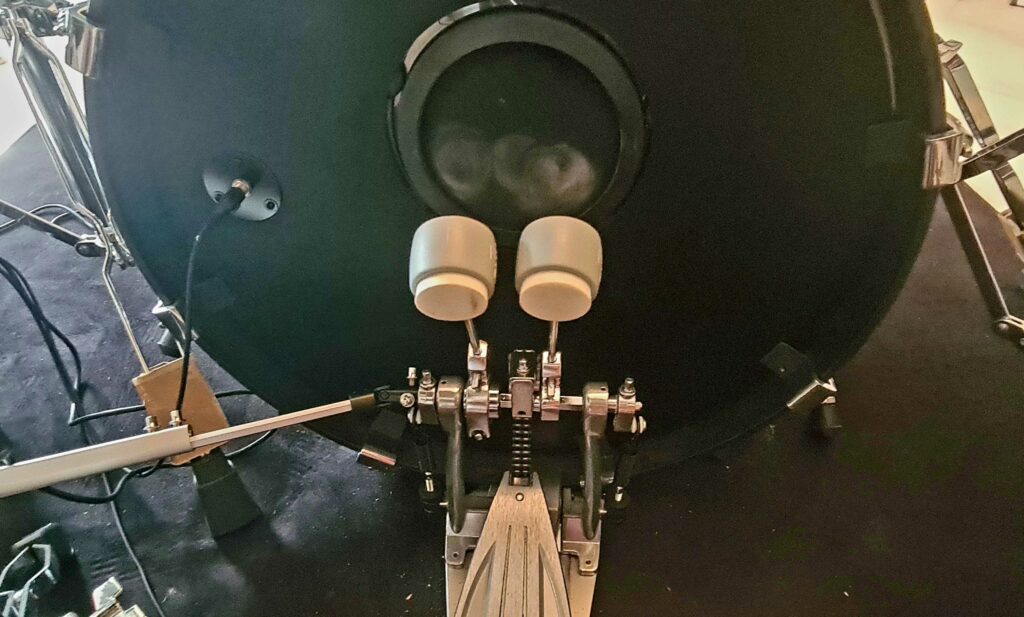
However, it’s worth noting that adding a second kick drum pedal (using my Tama Speed Cobras) took a few goes to get right. While the kick drum is 20 inches, the actual sensor pad of the kick drum is only 6 inches.
This means you’ll need to angle the kick pedal’s clamp slightly off to one side (or else the slave kick drum hits outside the sensor pad zone). This causes the kick drum clamp to attach to the kick drum at an awkward angle.
I got it working well in the end. However, for future iterations — it would be nice to see Roland offer a slightly larger kick pad zone to accommodate for double-pedal players.
Build Quality (7.5/10)
The actual kit – the shells of the drums, and the mesh heads made me feel confident when playing (even with a heavy hand).
This kit will easily be able to withstand years of playing from even the hardest hitters.
That said, it is still up to you, the drummer, to practice good playing technique in order to keep them in great condition. Much like real acoustic cymbals and drum heads, electronic drums are not immune to cracks and breaking. In the past decade that I’ve owned electronic drums though, I have not once cracked a Roland cymbal, so I can attest that they are as durable as they get.
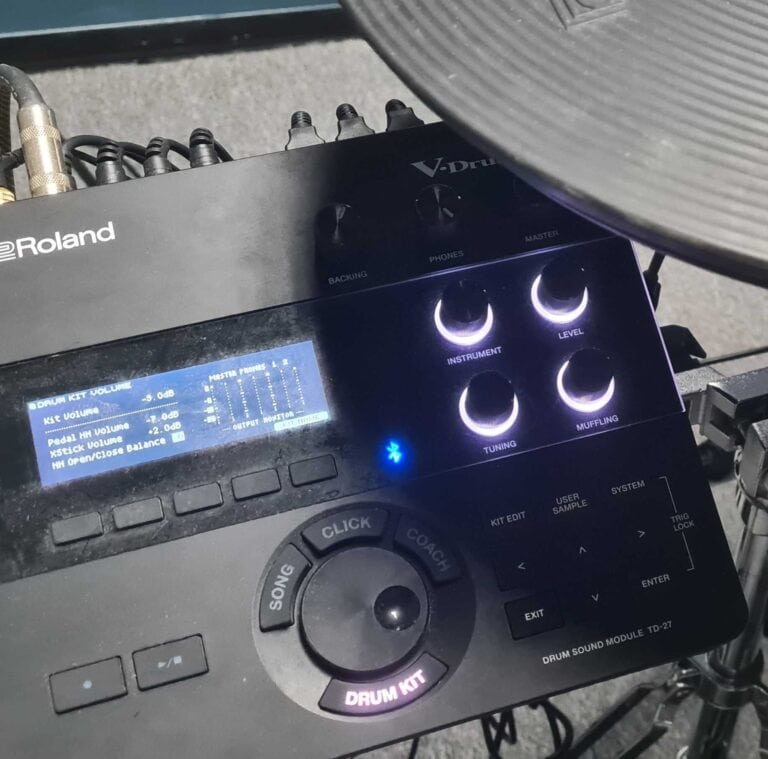
We can’t talk about durability without mentioning the module of the drumkit. And here’s where the kit loses a few points, unfortunately.
It’s bizarre that a drumset built so rugged and sturdy was accompanied by a module encased in lightweight plastic. It makes it hard to give the kit top marks… because the kit is built like a tank in all other aspects.
That aside, the knobs and switches on the module are all well constructed, and the LED display is clear and large enough to read.
Sound Quality (8/10)
Overhauled Sound Module
The module has gone through an overhaul from the old days (I used to own a TD-30. I love that it can now serve as a soundcard that can output both MIDI and audio.
Although it does have some weird quirks that require you to menu dive a bit… Like having to set the system to “Vendor” mode to be able to do record both MIDI and audio.
Drum Kits
Roland’s choices of kits are mostly great, but some could be better. There were a fair few patches that I’d never see myself using in. However, your mileage may vary, depending on what you intend on using the V-Drums for.
If you’re the type of drummer that loves experimenting with sci-fi tabla percussion sounds and EDM kits, this kit does it all.
There are a total of 75 kits inside the VAD507. Instruments can also be layered so that there is a main instrument and a sub-instrument, which is not out of place considering Roland’s pedigree in synths and drum machines.
A common critique of the Roland stock kits is that some of them can sound a little too ‘clinical’. While entirely subjective, the TD-27, does give you more than enough control to dial in your tones the way you like.
Everything from your standard ADSR envelopes to control over mics, snare wire bleed and more — is at your fingertips. So there’s really no excuse for not being able to get a good sound out of the module.
One aspect I really enjoyed about the TD-27 was the ability to zone in on the amount of compression on each of the pads.
The master compressor even has a dry/wet function, which lets you get hands-on with advanced settings like parallel compression.
While there are loads of amazing kits, it would have been nice to have some ‘artist signature’ kits programmed in, like a ‘Travis Barker’ or ‘Matt Garstka’ preset (for those who want to sound like their idols).
Value for Money (7/10)
The VAD507 has good value for the money because they’re built to last.
However, it is hard to give high marks for value for money when there are Roland budget kits out there that are comparatively expressive and will get the job done just as well.
Roland knows their target market with this kit though – drummers who value looks as well as playability. And while the price tag is steep, you are getting a truly premium product.
The only kit priced higher than the VAD507 is the VAD706, which features larger shells, different finishes, and the flagship TD-50X module.
Aesthetics
The ‘wrap’ around the drums, while I’m not the biggest fan of sparkle finishes, it looks really, really good.
Friends who have come over and checked it out (even non-drummers), the first thing they comment on is how good it looks. The VAD line was meant to look like a real kit, and yeah, it does.
However, brace yourself with the inevitable cable management job that is just part of owning e-drums. Get it right, and you’re golden. But if you’re anything like me (an unorganized mess), it’s quite easy to end up with a nest of V-Drum cables around your kit. Oh, they do give you a few velcro cable ties to help with that though, so that was nice.

Other Quality Of Life Features:
- MIDI and audio multi-tracking via USB
- 3 extra aux inputs for upgrading your kit with more pads/cymbals
- Import your own sounds via SD card
- Updated Pure Ambience sound technology
This kit makes it extremely easy to record. Everything can be done on the instrument itself. You can also import your own sounds through an SD card.
The VAD507 has a multitude of ways they make this model sound more realistic, including continuing to hone their Pure Ambience technology, which creates an immersive playing experience by placing virtual mics.
Connectivity/ Bluetooth
Bluetooth feature is AWESOME to have. It is so nice to load up anything via Spotify/YouTube and play along to it. However… the Bluetooth connectivity proved a little problematic at times.
This might have just been a personal issue due to interference in my house (I do have a fair number of Bluetooth devices running). However, it’s 2023… So to expect song skipping and regular Bluetooth dropouts is a bit of a bummer.
Reddit posts like this prove I am not the only one out there with this issue. I also did reach out to Roland for comment, and while they acknowledged that they have had a few reports come in similar to mine, they are convinced it is more an issue with the connectivity/reliability of my phone’s Bluetooth, rather than being a hardware issue.
Issues I Had With The Kit
Out of the gate, I found that the velocity settings were tweaked a little too sensitive for my liking, particularly with snare ghost notes. Your mileage will vary with this, as it’s due to the fact that I strike the drums harder than most (my light touch could do with some work). Anyway, velocity settings were easy enough to adjust so that recorded MIDI notes weren’t hitting at 127 where I didn’t want them to.
Also, while the kit was able to distinguish between open hi-hat and closed hi-hats direct out into headphones/amp, when looking at the recorded MIDI notes, I did notice that a lot of my closed hi-hat notes were appearing as open. This required a little bit of menu diving to resolve, and you can see the solution to misfiring open-hi hats here.
Roland VAD507: Pros and Cons List
|
Pros |
Cons |
| Overhauled module with better sounds |
Not a ton of useable/basic patches |
|
Real wood shells |
No artist signature kits |
|
Improved instrument hardware | Cheap housing for the module |
|
Easy to adjust the volume of individual pads |
The volume of the foot pedal is far too loud by default |
| The pads are durable and will hold up over time |
Kick drum trigger area is a little tight for double kick setups (but does work). |
|
One of the sleekest, most updated kits on the market currently |
No timbre difference in the hi-hat’s bell |
|
The cymbal wobble is more convincing than earlier models |
The bell area of the ride is still a bit small |
|
The hi-hat has a bottom plate, which increases the realism |
Occasional menu-diving is required to get to what you need |
|
The foot splashes on the hi-hat pedal are responsive |
The instrument, as well as the replacement cymbals, are costly and might not be in everyone’s budget |
|
The snare has 8 sensors resulting in more sensitivity and several timbres |
No variety in shell wrap (it only comes in sparkle wrap) |
Comparable Instruments
I hesitate to compare the VAD line to anything besides itself – but the VAD-506 is a comparable step-down instrument with arguably better value for the more budget-conscious buyer.
The VAD506 has an older version of the TD-27 module, lacks the new digital hi-hat and improved cymbal hardware. So if that isn’t a dealbreaker for you, the VAD506 could be a good compromise.
On the flip side, their pro-level V-drums, like the VAD706, come with a much larger (22-inch) bass drum, which is a stunner to play on. Prepare to fork out even more for that, though!
Final Thoughts
Other brands have done well to catch up to Roland in recent years, but these new digital additions have once again raised the bar for the rest of the industry.
The housing for the TD-27 sound module was a little delicate for the price, and there were some aspects of the instrument I had a hard time accessing without a full-on menu dive. That said, I still came away from the instrument with the following thoughts:
- The cymbals are the most realistic and responsive I’ve ever witnessed in electronic drums
- The pads and cymbals are rugged enough to take wear and tear from even the heaviest of hitters
- The module’s editing flexibility is unmatched.
While the Roland VAD507 isn’t the most economical choice out there, you’re paying for the glamour of having full-sized shells and a kit that not only feels — but looks like the real deal. It’s up to you to decide whether or not that’s worth paying a premium price for.