- The must-know chord progressions of modern music
- Significant chord progs from back in time
- Why these progressions are so compelling and essential
- Also, check out our post on all the different types of chords!
Do you have loads of lyrical content but struggle to create the shell of a song?
Or maybe you’d like to really understand the top 40 tunes on the radio.
In this article, I can help you with both! Last time, I taught you how to write emotional chord progressions and how to make that initial seed of an idea into something more heartrending.
But now, it’s time to hit rewind and return to the basics…
In each section, I’ll give you examples of the progressions both in the context of popular tunes as well as ‘bare-bones’ ukulele recordings.
Along the way, I’ll tell you some tips and tricks on when to use these progressions in your own songwriting process.
Common Chord Progressions
The “Four Chords”

These are the most common chords used to write pop tunes.
The Axis of Awesome’s “Four Chords” song shows just how many tunes use the following chord progression: 1645 (In C, that’s C Am F G).
While that band’s song had over 30 tunes, there are far, far more than that that use this progression or some variation of it.
The I vi IV V chord prog was popularized during the 1950s doo-wop era. On a fun note, you could say that Bruno Mar’s Doo-Wops and Hooligans album is indeed historically accurate. The first known example of 1645 is from the 1936 tune “Blue Moon.”
Many would argue that this particular set of chords is overused and overrated. On one hand, I agree, but on the other, there is a reason why it’s such a good underlying shell of a song.
This chord progression avoids putting chords I and V (aka C and G) next to one another in each set, which makes the song feel like there’s more to tell and “it’s not over yet.”
Once you know I vi IV V on a chordal instrument, you can learn hundreds (if not thousands) of songs. Beginner and seasoned songwriters alike get a great response from songs that sound like this.
Use the I vi IV V progression when you are looking to make something feel propelled forward, poppy, sensitive, and loving. But it’s so ubiquitous and versatile that it’s also been dubbed the ‘pop-punk’ chord progression, so do with that what you will.
Song examples:
Apologize by OneRepublic
You Make Me Feel Like a Natural Woman by Carole King (verses only)
Check Yes Juliet by We The Kings
Despacito by Luis Fonsi
Chord Progression Recording:
6415
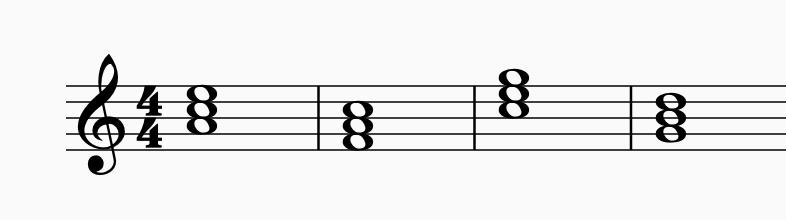
This is another popular way the chords are ordered.
Similarly, the 6415 is another common order musicians put these chords (in C, this is am F C G). I find it even easier to stick to the 1645 pattern for longer periods of time. This is because it doesn’t put 1 and 5 next to one another at all.
As the chord progression repeats, listeners stay completely on their toes and don’t feel quite as much release from that tension as the last example.
So, songwriters often use this chord progression for long sections/repetitive verses when telling a story or painting a picture in their minds.
The 6415 has been dubbed the ‘sensitive female chord progression,” which makes me want to laugh…there are many male artists who use it, too!
That said, artists tend to use it for emotive (and sometimes bleak) tunes. “Hello” by Adele is a textbook example.
In this order, the popular chords have a more compelling, melancholy vibe. There is even an entire blog dedicated to all the songs with this progression.
Song examples:
Face Down by The Red Jumpsuit Apparatus
Love It When You Hate Me by Avril Lavigne (ft. Blackbear)
Hello by Adele
Chord Progression Recording:
The Turnaround (ii V I)

The basis for many chord changes in jazz and modern genres ii-V-I in C
The ii7-V7-I7 turnaround progression comes from jazz. These chords are directly from George Gershwin’s tune “I Got Rhythm.”
Oftentimes, this is just referred to as “rhythm changes”. If we are in C, this is Dm7 G7 Cmaj7 (don’t mind the jazzification).
This progression is on the must-know list because this set of chords can help musicians change keys or establish the key really easily. This move creates tension, more tension…and then resolves! R&B takes a lot from this short, head-tilt-worthy set of chords.
Song examples:
Take the A Train by Billy Strayhorn
Autumn Leaves by Joseph Kosma
Chord Progression Recording:
Extensions of ii V I
6251 (VI ii V I) and 16251 (I vi ii V I) are both more complex versions of 251. The first, 6251, would be (Cmaj7 – Am7 – Dm7 – G7 – Cmaj7) in C.
This is known as “The circle progression” because it travels along the circle of 5ths ( a building block of music theory).
The other progression simply adds a 1 chord up front- it is a bit less common. 241 is another, more modern-feeling offshoot of the 251. This one is typically found in rock and pop.
Traditionally, jazzers added 7ths to all of these 251 variants. We often exclude some (or all) of these 7ths in other genres.
Other 251 Progression Recordings:
6251 (no 7ths):
16251 (with Cmaj7 as 1):
The Backdoor Progression (vi7 bVII7 I)
This is commonly found in jazz standards and is considered a tritone substitution, meaning that musicians ‘borrow’ from another key to get the same sound. Once you know the backdoor prog, you’ll hear it everywhere.
It is called the “backdoor” progression because it is another, more complicated way to get to that 251 turnaround sound I mentioned earlier.
In C, the chords would be Fm7 Bb7 Cmaj7. The Bb7th feels like (and replaces) what would be the V (G7 in C). The reason why this (surprising) chord sounds similar is because they have two notes in common.
Song examples:
Ladybird by Tadd Dameron
Stella by Starlight by Victor Young
Chord Progression Recording:
145 and 1545

I IV V in C
145 (C F G) is one of the most widely found chord progressions. With only three chords, musicians have written thousands of songs with it, both new and old.
Some people consider 1545 to be an extension of 145, but I don’t. This short progression feels slightly more peppy than 145 and isn’t used as often.
However, both feel like a half-cadence because they end on the 5. (For reference, a cadence is a short chord progression that ends a phrase/section/song).
145 Song Examples:
La Bamba by Ritchie Valens
I Write Sins Not Tragedies by Panic! At the Disco
Helpless by Neil Young
145 Chord Progression Recording:
1545 Recording:
The 12-bar Blues

Notice how all the chords are dominant 7ths, with the flattened 7th up top.
The 12-bar blues chords go like this: I IV I V IV I (or V), and everything is a 7th chord! In plain-speak, a 12-bar blues in C major would be C7 F7 C7 G7 F7 C7 (or G7, more on this alternative ending on moment…)
The interesting thing about this chord progression is that the rhythm is always included along with it. All the other progs on this list can have a different rhythm! Classical rock uses this progression all the time.

This progression is often played swung or slightly relaxed.
It’s easier to think of the 12-bar blues as three sets of four measures. It goes like this: four measures of I, two measures of IV, two measures of I, one measure of V, one measure of IV, and two measures of 1.
This is in a different section than the other I IV V songs because blues artists usually use dominant 7th chords to get a different, crunchier sound. Blues often adds a ‘turnaround’ at the end as well, but this is usually just the 5-chord rather than the 2-5 turnaround of jazz.
This is the optional five you see. There is also a jazz blues, but that’s neither common nor do we have time!
Also, check out Chord and Harmonic Functions In Music (A Crash Course).
Song examples:
Pride and Joy by Stevie Ray Vaughn
Johnny B. Goode by Chuck Berry
Something Like Olivia by John Mayer
Rock Around the Clock by Bill Haley and His Comets
Chord Progression Recording:
Pachabels’ Cannon

(Some of these chords are put up an octave for ease of reading.)
If you’ve read our other article, you already know a bit about this canon. Pachael’s Canon is a classical piece that was first written in 1680.
Surprisingly, songwriters still use it all the time. I think it’s a great option, as it’s longer than most of the other popular progression, at 8 bars. It’s most often used in pop nowadays. It’s really easy to loop.
Just because chord progressions are popular doesn’t mean they can’t be longer or somewhat complex. This progression is I–V–vi–iii–IV–I–IV–V. The original version is in D and uses the chords: D A Bm F#m G D G A.
The 4ths used in this key make it sound warm. It’s like a blank slate for melodies; you can do anything with it.
Song examples:
Basket Case by Greenday
Memories by Maroon Five
Chord Progression Recording:
The “Creep” Progression

Notice how many accidentals are in this one! I III IV iv (G B C Cm if we are in G)
Of all the common progression on the list, this one would have to be my favorite.
What makes it sound so different is that this prog has a lot of switcheroos. What would normally be the minor 3 chord is now major, and what would normally be a major 4 chord in the key is now minor, too.
This use of a secondary dominant chord gives it an edge when we compare it to the other progressions on this list.
Songwriters often use this song if they want to express mixed emotions, like how “Creep” sounds both hopeful and melancholy.
Also, check out Weird Chord Progressions (Examples & How to Make Them).
Song examples:
Vampire by Olivia Rodrigo
Magic City by Gorillaz
The Air That I Breathe by The Hollies (Radiohead was actually sued for this song for using the same chord prog and similar instrumentation and melody!)
Sick of You by Suriel Hess (first vers)
Creep by Radiohead
Chord Progression Recording:
FAQs
How Do Musicians Make So Many Different-Sounding Songs From All Of This?
Texture, texture, texture! Also, tempo, instrumentation, and vocal timbre. Lyrics go a long way, too.
What Is A Root Progression?
Some folks talk about root progressions as if there were only one, but that’s not true. Any chord progression can be a root progression, and oftentimes, the above common chord progressions are!
Root progression means that the chord is in root position, meaning that the lowest note is the first note in the stack.
How Can I Find More Songs With These Progressions?
Chord Genome is a really neat tool to use in order to search songs with certain chords to find samples for this article. I used it to help find some 145 tunes of different genres.
If you’re a beginner at your instrument, you can find songs to play with this tool, which I think is pretty cool.
What Are Some Popular Rock Chord Progressions?
The I ii iii ii I V (C Dm Em Dm C G), which (as you can see) uses many minor chords next to one another, results in that ‘epic rock’ and Sabaton-ish sound.
Another common progression that is often used for parts of rock songs is I bVII (yep, borrowed from jazz!).
Before you go, check out our article What are Chord Tones (The Ultimate Idiot’s Guide).