- What are the main types of drums used in popular genres of music?
- Learn about common world drums and hand percussion
- And learn some fun facts like when and where each instrument was first made
When I started learning more about types of drums in a class called Percussion Methods at the University of Toledo, my arrangement game was upped by at least 50%.
And while learning to identify different drums might sound easy or basic, that isn’t always the case! There is a lot of nuance here.
Before Percussion Methods, I never listened to “Come and Get It” and thought, wow, that beginning sample has an excellent tabla!
Anyway…!
Once you recognize the types of drums other artists use, you can better emulate the specific sound you’re looking for.
So, if you’re interested in learning more about percussion, you’ve come to the right place.
Even if you aren’t a drummer, knowing more about the types of drums and their applications will help you better produce music.
In this article, I will guide you through a plethora of drums you should know: from most to least well-known, and give you some tidbits of history and genre context along the way.
Types Of Drums – Categories
Before I get into specifics, let’s lay down the groundwork. Drums/percussion can be categorized into the following groups: Pitched and unpitched.
Pitched means that the instruments have a recognizable tone and unpitched means that they don’t.
While yes, everything technically has a pitch, unpitched percussion is not intentionally tuned.
One example of an unpitched percussion instrument is a triangle. An example of a piece of pitched percussion would be a xylophone.
Most things that we define as a ‘drum’ are technically membranophones. Membranophones have a piece of leather or plastic (a membrane) stretched over a hollow base.
Percussion/hand percussion, on the other hand, can be divided into other subcategories, like shakers, scrapers, and more. In this article, I will be primarily focusing on drums with heads.
Drumsets
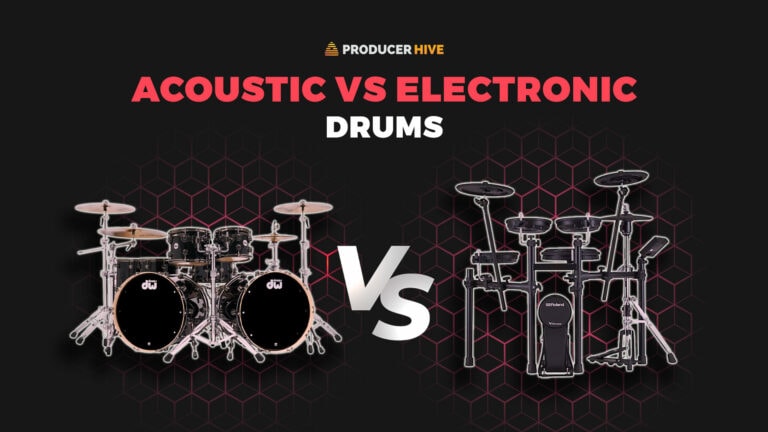
Let’s start with the most obvious: drumsets! Drumsets can be divided into two main categories: Acoustic and electronic.
Drumsets are used in everything from pop to rock, metal, jazz, country, indie, hip-hop, and more.

Acoustic
Acoustic drumsets include the following instruments:
- Snare drum
- Kick drum
- Toms (tom-toms)
- Hi-hat
- Ride cymbal
- Crash cymbal
Of these instruments, only the first 3 on the list are membranophones. Hi-hats, ride cymbals, and crash cymbals are all unpitched percussion.
However, they are considered a part of a drum set, so it is important to include them here!
It is worth noting that there is a significant timbral difference between acoustic rock kits, metal kits, and jazz kits, which are the 3 primary kinds of sets you’ll see for sale.
Kick Drum and Snare Drum

The snare and bass/kick drum are the core of the drumset.
Kick drums are a type of bass drum in drum kits and are triggered by a foot pedal attached to a mallet (typically) with a soft head.
These drums don’t produce a definite pitch. They usually play on 1 and 3, operating inversely to the snare.

Snare drums can be made of either steel or brass. The snare drum typically hits on 2 and 4 within a 4/4 time signature for basic beats.
Snare drums sound bright because they have a set of wires underneath the drum. Said wire can be switched ‘on’ and ‘off,’ though.
Toms

Toms are the drums that are to the right of the player. There are typically at least 3, sometimes more.
Toms are also known as tom-toms and are shaped like snares but don’t have any wires. These drums sound clear and descend lower in pitch as you play further away from you.
Toms are used for drum fills, which usually happen during changes in the music (transitions).
One interesting fact about tom-toms is that they originated in China and had heads that were glued on and intricately painted.
Cymbals
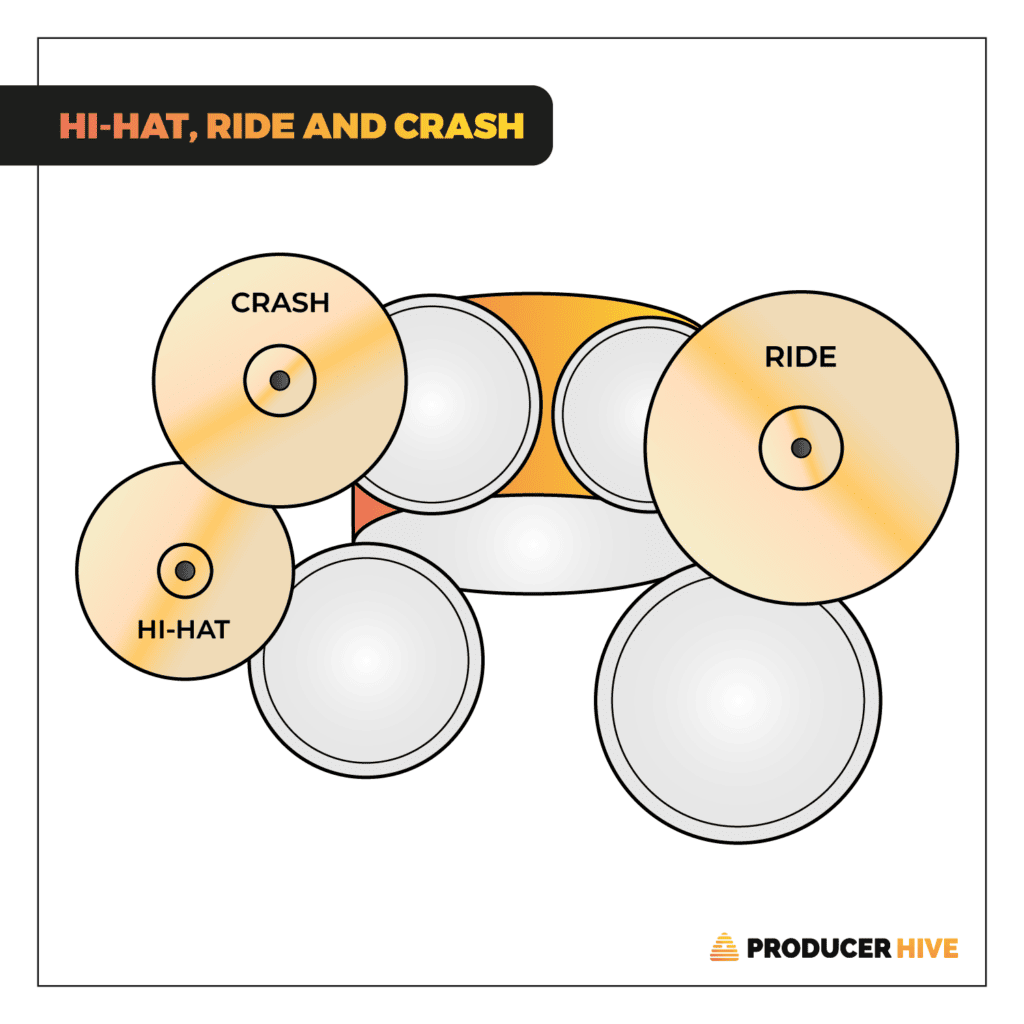
The last 3 pieces of percussion on our drum kit list are made of metal. A hi-hat is comprised of cymbals put together, like two coconut shells.
It can be played open or closed by using a foot pedal. When they’re open, they sound very ringy, with many overtones, making an ‘sss’ sound. When closed, hi-hats sound short.
Ride cymbals are darker than high hats and are usually the biggest cymbal in the kit.
While ride cymbals are used for beats, crash cymbals are typically only used (fittingly!) for crashes, accenting key moments in the music.
Kit drummers of all genres often also employ hand percussion into their repertoire. These include wood blocks and bells, usually on a metal stand.
*For more information on cymbals, check out our article on ‘How Many Cymbals Are In A Drum Set?‘.
Electronic Kits

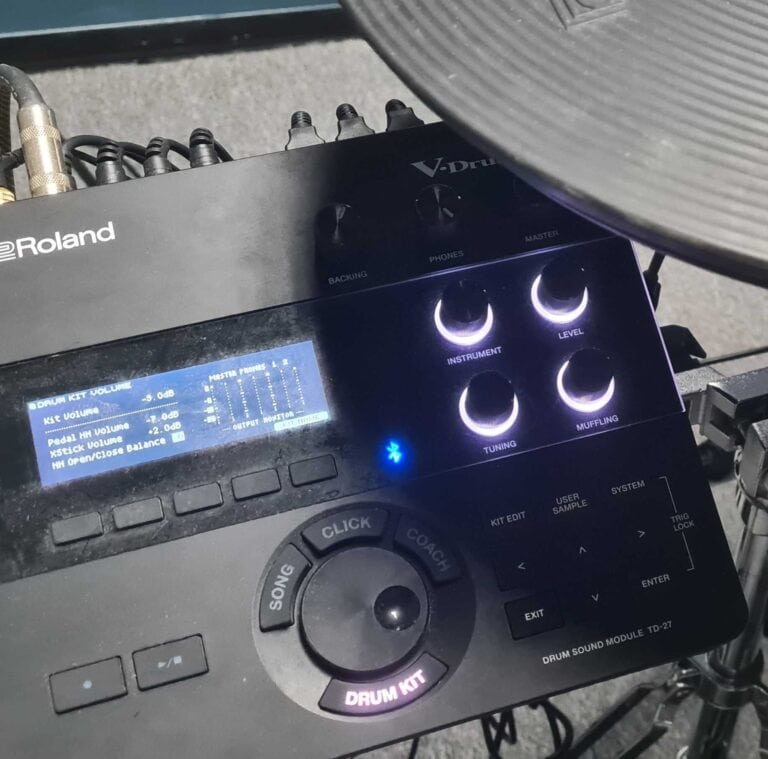
Electronic drum kits usually have the same basic setup as acoustic kits: Snare, base, toms, hi-hat, one ride cymbal, and one crash cymbal.
Some common brands of electronic kits include Roland, Alesis, and Simmons.
One con to the electronic drumset is that it can be more difficult to expand since they need to be wired to the base. Some sets are more capable of expansion than others.

Drummers often expand their palette of sounds by adding a sample pad rather than connecting more instruments.
Sample pads are electronic drums played in small blocks on a soft, bouncy grid.
The cool thing about this is that you can record any sound you like (on an acoustic drum, wind instrument, or whatever!) and transport it into the pad.
Marching Drums / Military Drums
Most of the drums in drum kits come from military bands originally. Snares, bass drums, and cymbals all used to be taken on the field into battle.
Marching drums follow similar rhythmic structures (I.E., bass drums playing on one and three, etc.) but often look slightly different. Miliary-style base drums are huge and typically worn by the player.
One type of military/marching drums that you won’t usually see outside on the field are tenors drums.
Tenor drums can be divided into two categories, and they are separate from one another: quads and Celtic tenor drums.
In the U.S., quads are a set of 4 drums fastened to the player’s body.
On the other hand, Celtic tenor drums are clear-sounding cylindrical single drums used in drum and pipe competitions.
World Drums
- Double hand drums
- Steel drums
- Single drums
Double Hand Drums
Conga
Conga are double drums from Cuba. They are tall and narrow.
Often, they are confused with bongos, but those are quite different. Congas sit on the ground, whereas bongos sit on your lap.
Conga drums are relatively low in pitch and traditionally used in Afro-Cuban music, but they can now be found in everything from jazz to Latin.
Bongos
Bongos are a set of small drums from Cuba. They are also used in Afro-Cuban music but have become extremely popular with musicians worldwide (Even Justin Beiber used them in acoustic renditions of his songs).
Sometimes bongos are placed on a stand above Congas in a performance setting so drummers can access both instruments simultaneously.
Tabla
Tabla is a set of two drums from Indian Classical (Hindustani) music.
Tabla are unique; they are one of only a handful of drums from the Indian subcontinent, which have dough on the top of the drum heads to aid in pitch bending.
Tabla can now be heard worldwide in film scores and pop songs.
Steel Drums
While you might hear a steel pan and a hand pan being referred to as a ‘drum,’ technically, they’re not drums to a musicologist!
These two metal percussion instruments are idiophones. But don’t fret, I’m not being insulting. An idiophone is simply an instrument with a sound created from internal vibration.
Steel pans are from Trinidad and are usually played in ensembles. You’d be hard-pressed not to like their bright warm, shimmering timbre.
Steel tongue drums, on the other hand, are historically new instruments. They have a darker sound and are often used in meditative tracks.
Single Drums
Historically, single-headed drums were some of the first to be created. There are dozens of single-headed drums worldwide. Some examples include:
- Frame drums like the Irish Bodhran
- Djembe, tubanos, and chimbangueles (From Africa)
- The timbau (From Brazil)
- The doumbek (North Africa, Parts of Europe)
- The cajon (Peru)
Frame drums have an open back, whereas many other world drums are tube-shaped or, are goblet drums with a wide top, like the doumbek.
Open-frame drums have a very different timbre than the taller world drums I mentioned.
Frame Drums
Frame drums originate with the Ancient Celts.
The Celts originally uses these drums to celebrate art and sing religious (Pagan) songs. Frame drums are far wider than they are deep, giving them a unique tone.
Today, frame drums are often seen playing in small European pubs, with pipers and guitarists, or in big acts like Riverdance.
Djembe, Tubanos, Chimbangueles
Many types of single-head drums and hand percussion originated in West Africa.
Two of the most common include djembe and tubano. The djembe is goblet-shaped, so the top is much wider than the bottom. They are tuned by ropes.
Tubanos, on the other hand, are long, straight drums with skin-heads. They are very accessible instruments to play and can be used with mallets or just your hands.
You’ll often see them in elementary music classes because they’re so straightforward (and affordable).
And Chimbangueles is quite possibly the original ‘drumset’! This 7-piece collection of instruments is traditionally divided among men and women, who create a musical call and response.
Timbau
The timbau is a drum from Brazil. Timbau are conical drums that are often made with aluminum or wood.
The drum comes from earlier membranophones from Africa, originally tuned by a campfire (called caxambu). They can be quite bright in timbre.
Doumbek
The doumbek is a goblet drum from the area near where Northern Africa meets Europe. It is also known as the darbuka.
It can sound metallic or woody, depending on where you play it. It is often held to the side, resting on one leg.
Check out our guide to doumbek vs darbuka here!
Cajon
A Cajon is a wooden box with a sound hole played with your hands. The word ‘Cajon’ means box in Spanish!
Like the steel drums we looked at earlier, this isn’t a true drum, but rather, an idiophone.
There are 3 different types of Cajon: Flamenco, Peruvian, and snare cajon. Many Cajons have snares inside. The pitch of the Cajon can be higher or lower, depending on where the box is struck.
The Cajon has roots in both Peru and West Africa. It is thought that slaves from Africa brought their rhythm to Peru. They couldn’t bring their drums to the ships, so they used wooden boxes instead.
Thus, the Cajon was born. It is now used in fusion waltz music called ‘vals criollo’. Buskers also tend to favor the Cajon- You can hear it accompanying many modern genres as well.
The Star of Orchestral Percussion: Timpani
As exotic types of percussion made their way across the world, instruments like the djembe and doumbek started being integrated into classical music.
More traditional instruments like the snare and other cylindrical drums are also integral. But even still, the king of orchestral percussion is the timpani.
Timpani, or kettle drums, are large tuned membranophones with foot pedals.
Timpanists have one of the most difficult jobs in the orchestra, as they have to tune for key changes quietly while the orchestra is still performing. In other words, they have to tune without a tuner.
Anyway…Timpani holds down the key center in the lowest range of the orchestra and often has a rumbling, rolling effect.
They are essential to many classical pieces and movie scores. It’s an unsung hero in popular (music) culture.
FAQ
What is the Difference Between a Bass Drum and a Kick Drum?
Both kick drums and bass drums are… bass drums! But there is a difference.
Kick drums are found in drum kits and are on the floor with a pedal. Bass drums in the classical context are huge membranophones that are suspended on a rolling rack.
What Are Some Popular Types of Hand Percussion?
Popular types of hand percussion that you might see include shakers like maracas-struck wooden instruments, claves, and temple blocks.
Scrapers like guiros are also common, especially in Latin and fusion music.
What is the Biggest Type of Drum?
The biggest type of drum in Western music is the bass drum, but the largest type of world drum is the taiko drum.
Taiko drums are traditional Japanese drums made from hollowed-out tree trunks.
What Is a Sitting Drum?
A sitting drum is simply another word for a Cajon!
Why are there So Many Drums?!
Drums were likely the second instrument ever created (second to the Neolithic flute).
There have been thousands of years of history and cultural development since the first drum ever came about, And honestly? I think it’s all extremely intriguing.
Wrapping Up
While it’s virtually impossible to catalog all the drums in just one brief article, I hope this guide helps you get your footing into the world of percussion- Or Membranophones! Feel free to send your questions in below!